China Market
Are Chinese Students Looking Back at America?
The Trump–Xi state visit produced a warmer political signal, and Chinese digital attention toward U.S. study rose sharply. That is not an enrollment rebound—but it is an early indicator worth measuring.
On September 24, President Donald Trump welcomed President Xi Jinping to the White House for the first visit by a Chinese president in more than a decade. The visit produced the language of a more stable relationship, and President Xi used his public remarks to emphasize people-to-people exchange, announce an invitation for 100,000 young Americans to visit China over the next five years, and raise the possibility of more direct flights between the two countries.
The subject was already on the policy agenda. A day before the meeting, the Council on Foreign Relations published an analysis focused specifically on rebuilding U.S.–China educational exchange.
For U.S. universities, that raises a practical question: could a more stable U.S.–China relationship change the direction of Chinese student mobility?
It is far too early to call an enrollment rebound. But attention may already be moving.
A sharp change in Chinese attention
AMB reviewed WeChat Index readings for a set of U.S.-related education terms before and during the state visit. From September 21 to September 24, the index for “美国留学” (“study in the U.S.”) rose from 5.91 million to 10.39 million, an increase of nearly 76%. “美国签证” (“U.S. visa”) rose about 41%, while “美国大学” (“U.S. universities”) rose about 17%. Over the same period, “中美关系” (“U.S.–China relations”) rose about 588%.
The comparison with other destinations is notable. “英国留学” (“study in the UK”) fell about 8%, “澳洲留学” fell 33%, and “加拿大留学” was essentially flat.
That pattern makes the movement look unusually U.S.-specific rather than a broad increase in overseas-study attention.
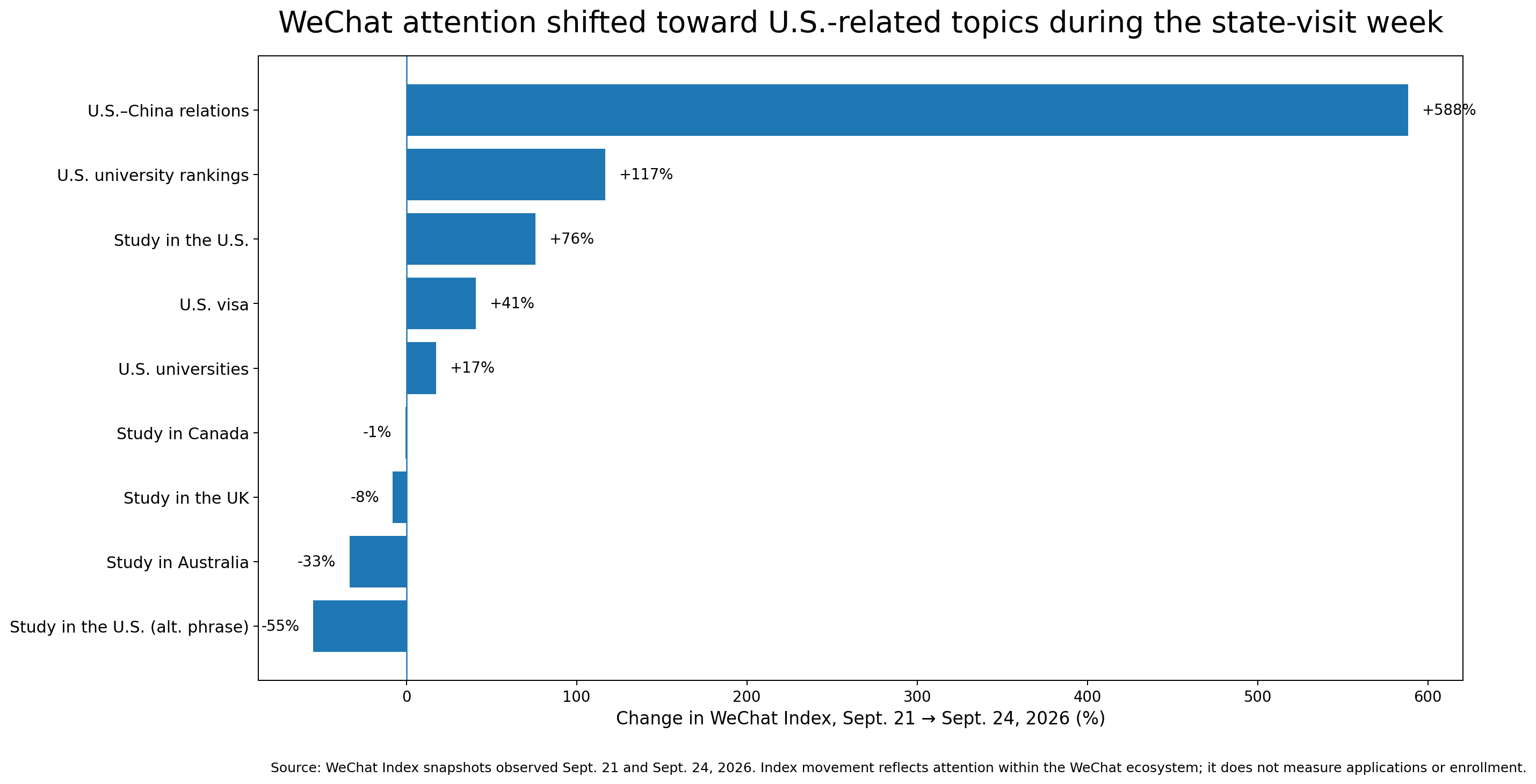
AMB analysis of WeChat Index snapshots observed September 21 and September 24, 2026.
It still does not establish cause and effect. The 2027 U.S. News Best Colleges rankings were released on September 22, and “美国大学排名” (“U.S. university rankings”) more than doubled in the same window. Another related phrase, “赴美留学,” fell rather than rose. WeChat Index is an attention measure inside the WeChat ecosystem, not an application survey.
The signal is worth noticing precisely because it is incomplete.
The underlying market has not disappeared
The longer-term data are mixed. Open Doors 2025 reported 265,919 Chinese students in the United States in 2024/25, down 4% from the previous year and well below the market’s earlier peak. Yet China remained the second-largest source of international students.
Common App data through February 1, 2026 offer another useful view. China was still its highest-volume country of citizenship among international first-year applicants, with 17,827 applicants, down only 2% year over year even as international applicants overall were down 9%.
That is consistent with an argument we made in our earlier analysis of international enrollment market divergence: a weaker global or historical headline does not tell an institution what is happening inside a specific market.
At the same time, important friction remains. The State Department’s current screening rules continue to apply online-presence review to F and M student visa applicants. The White House fact sheet released after the state visit did not announce a new F-1 policy. A warmer diplomatic signal should not be confused with a change in the operating rules students face.
Watch the sequence, not the headline
The useful question for enrollment teams is not whether “China is back.” It is whether several independent indicators begin moving in the same direction.
Start with attention: branded search, Chinese-language discussion, program interest and parent questions. Then watch whether that attention becomes attributable inquiry, application starts and completed applications. After admission, track visa questions, deposits and actual arrivals.
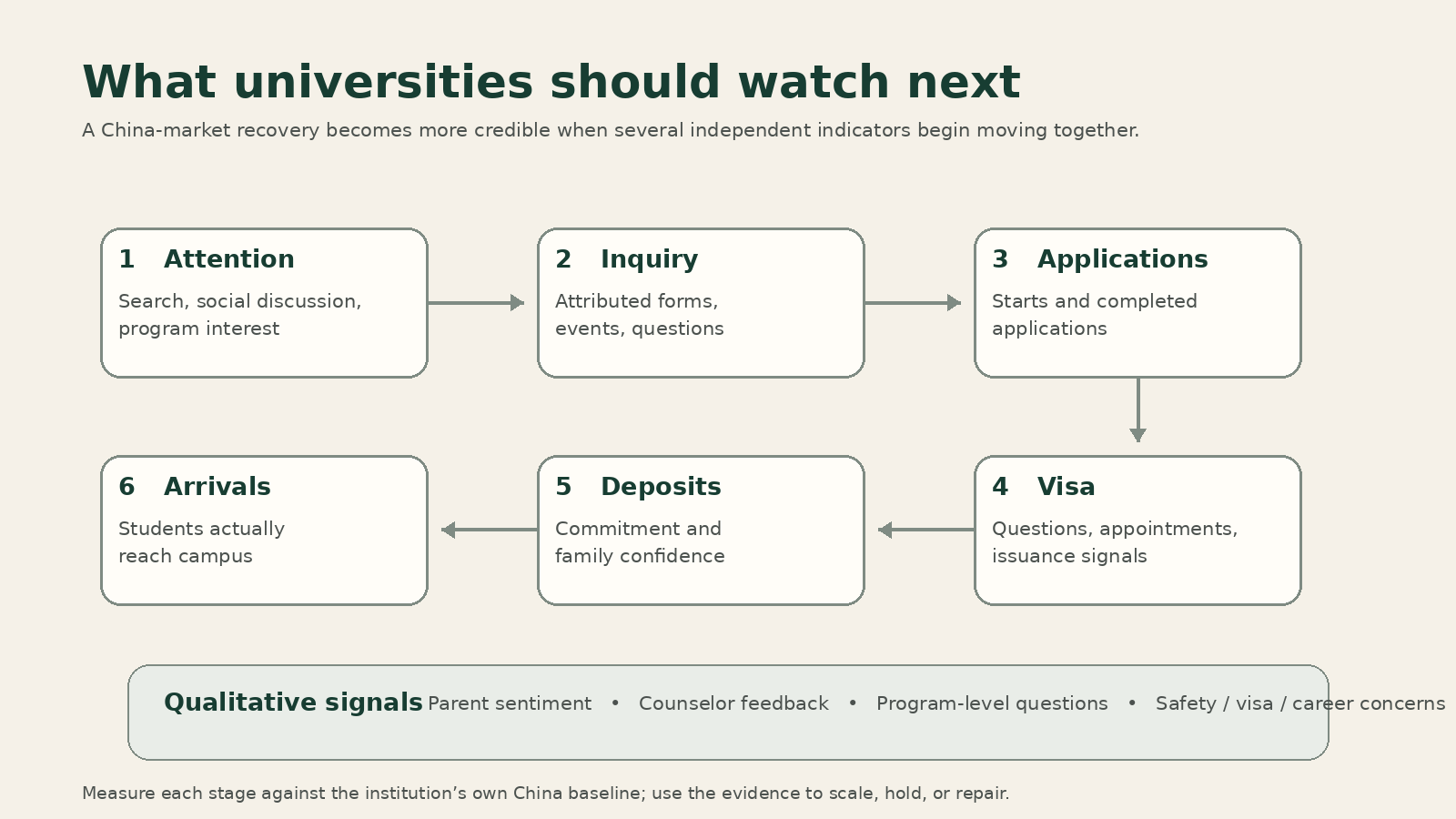
This is where a China discovery audit and connected market infrastructure become useful. If attention rises but institutional inquiry does not, the problem may be discoverability or decision content. If applications rise but deposits do not, the barrier sits later in the journey.
The observable outcome is not a promised enrollment increase. It is a clearer view of where movement is occurring. Measure each stage, compare it with the institution’s prior China baseline, and use the evidence to decide whether to scale, hold or repair the market approach.
The most defensible conclusion from this week is modest: Chinese attention toward U.S. study may be strengthening, but an enrollment recovery has not yet been demonstrated.
For institutions that once treated China mainly as a declining market, that is still worth watching. Attention is not enrollment. But changes in enrollment are easier to understand when the earlier signals are visible.
China Market Review
See whether China is moving for your institution—not just in the headlines.
AMB can prepare a tailored research + strategy overview proposal of up to 20 pages at no cost, focused on how your institution is currently appearing and moving through the China market. We can also spend up to one hour discussing the findings with your team. There is no commitment required, and we will provide candid, practical recommendations even if you decide not to proceed with AMB.
AMB Insights
Stay ahead of international enrollment shifts.
Get AMB Insights on international enrollment strategy, China-market intelligence, and market-specific enrollment infrastructure.