International Enrollment
A New Transfer Application Won’t Fix an Unclear Transfer Pathway
Common App’s transfer application is moving to a new platform for 2027–28. Universities still need to clarify credit, cost, eligibility and inquiry handoffs before launch.

For universities that recruit transfer students, a platform change can look like a technology project. For prospective students, the real question is simpler: Will my previous study count, and what will it take to finish a degree here?
That distinction matters as Common App prepares to bring its transfer application onto its main platform. Its published transition roadmap runs from October 2026 through August 2027, with the new application available for the 2027–28 cycle. Member institutions are expected to configure their transfer applications during the spring 2027 annual update process.
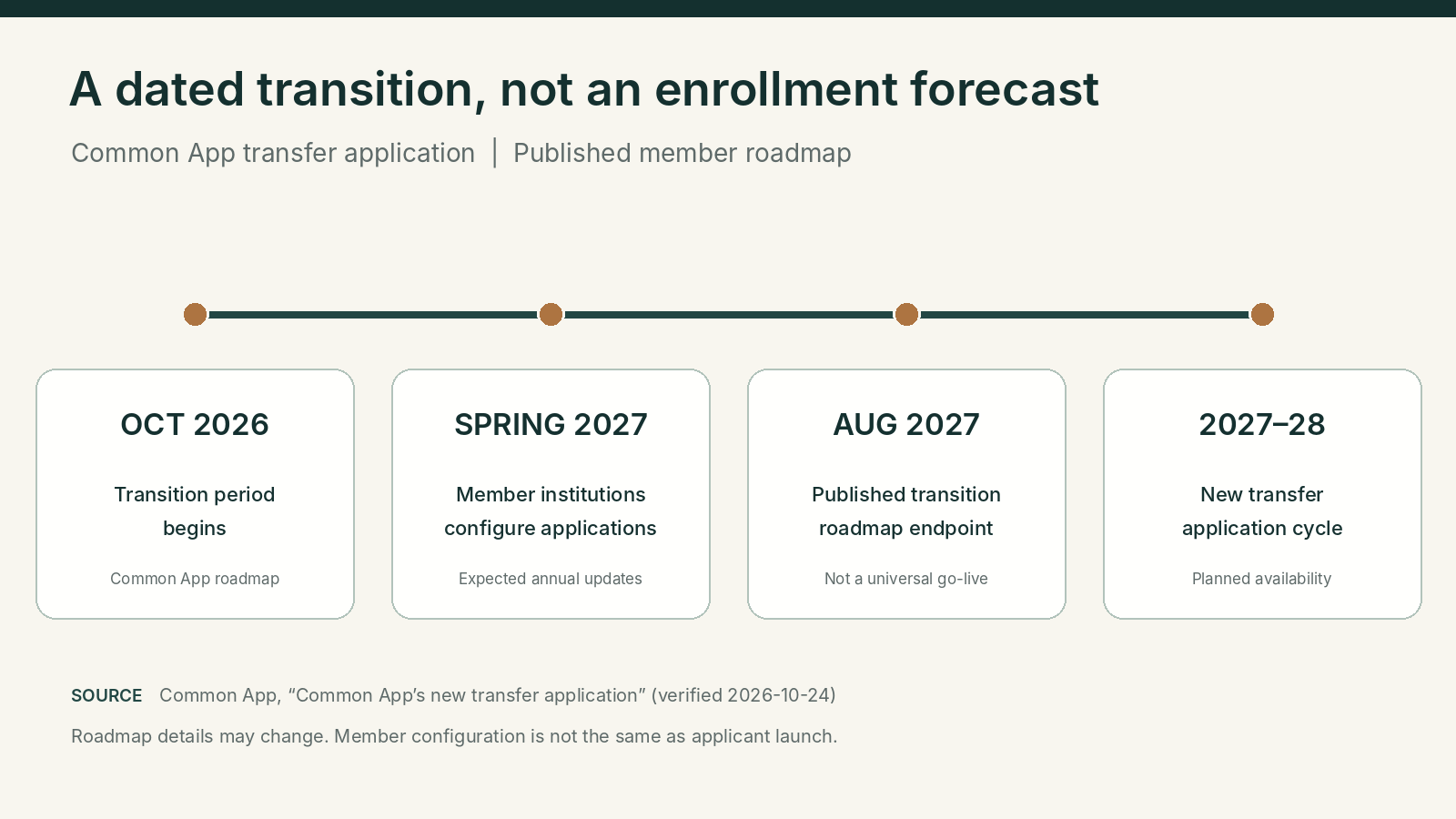
The transition creates a useful deadline for enrollment teams. It does not, by itself, make transfer eligibility, credit evaluation, cost, or institutional communication easier to understand.
The form is only one part of the decision
Common App says the new experience will bring first-year and transfer admissions into one environment. It also says transfer prospect data will be available through its Student Data Service and Control Center, and that it is working with admissions CRM providers on export templates for the new data catalog.
Those are platform commitments, not evidence that an individual university’s integrations or messages are already correct. Institutions still own their program requirements, credit decisions, response workflows, and student-facing explanations.
The National Student Clearinghouse’s March 2026 Tracking Transfer update reinforces why transfer should be treated as a distinct pathway: among first-time students who entered a U.S. community college in fall 2018, 31.6% transferred to a four-year institution within six years. That historical U.S. cohort does not describe international applicants or predict the effects of Common App’s redesign. It shows why the transfer journey merits its own measurement rather than being folded into first-year reporting.
For international prospects, the questions may be more complex. EducationUSA describes community-college-to-university transfer agreements as one possible route to a bachelor’s degree. But an agreement at one institution is not a promise that another university will accept the same credits. A student may also need clarity about foreign transcripts, language requirements, estimated remaining semesters, financial aid eligibility, and the appropriate institutional contact.
Diagnose the transfer answer before the data migration
An institution can test its pathway with four connected checks.
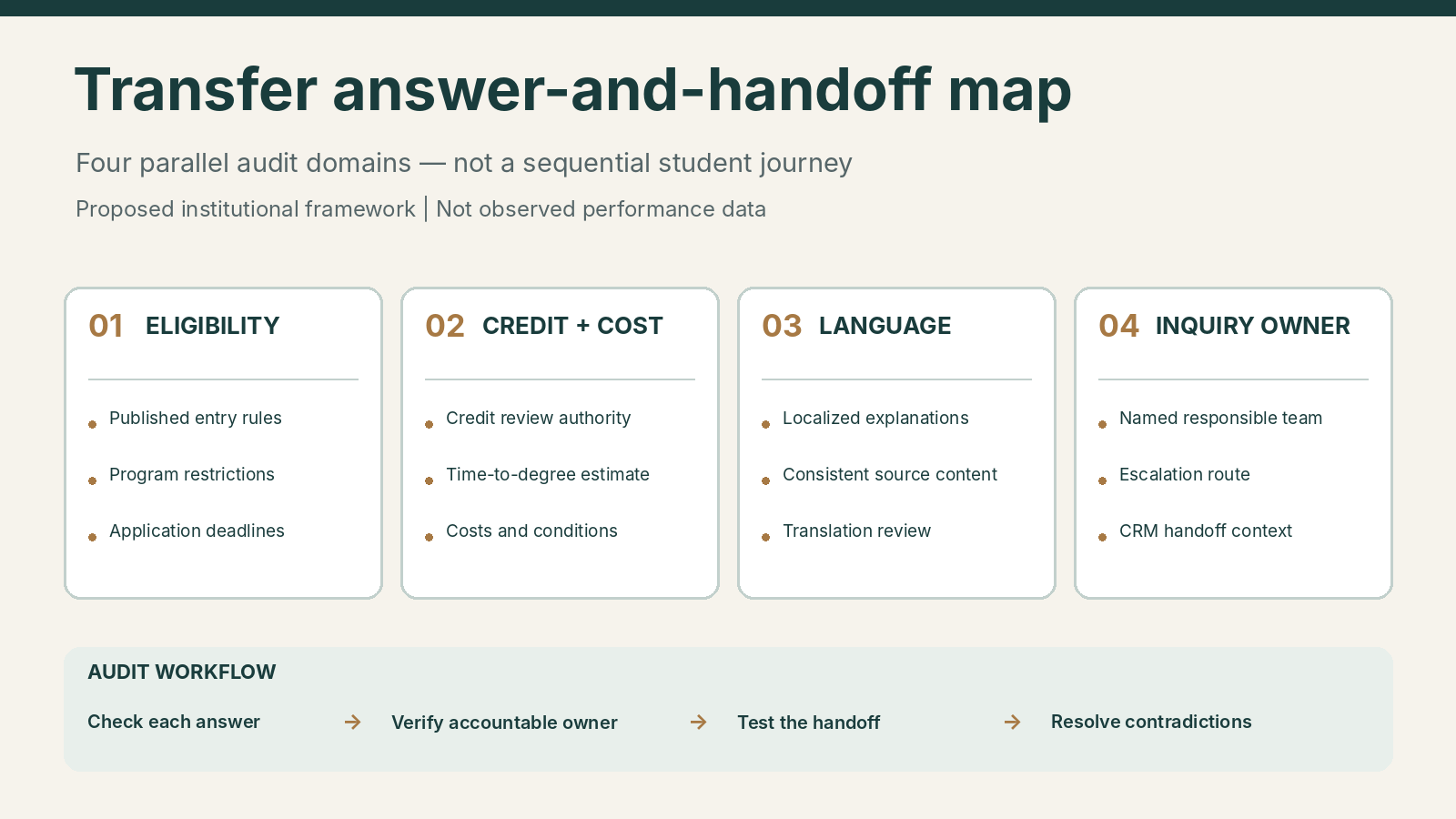
Eligibility: Can a prospect determine which programs accept transfer applicants, what prior coursework is considered, and which decisions require an official evaluation? Do not present a provisional credit estimate as a guaranteed award.
Cost and time: Does the public explanation distinguish published tuition from a student’s eventual total cost and remaining time to degree? Are scholarship conditions and deadlines specific to transfer applicants?
Language and trust: Do international and Chinese-language materials match the current institutional source? A translated “2+2” graphic should never imply an automatic two-year completion where course equivalencies, sequencing, or program capacity may change that outcome.
Handoff: When a prospect asks about credits or eligibility, does the inquiry preserve program, prior institution, entry term, language, and consented contact context? Does it reach the admissions or academic specialist authorized to answer?
This is where market-specific decision architecture and source-aware inquiry infrastructure become relevant. AMB can help map the public answers, localized touchpoints, and CRM handoffs. Academic units, registrars, admissions officers, and institutional counsel retain authority over credit, admission, and policy decisions.
Make the transition measurable
A useful pre-launch review need not promise more transfer enrollment. It should make the next institutional decision easier.
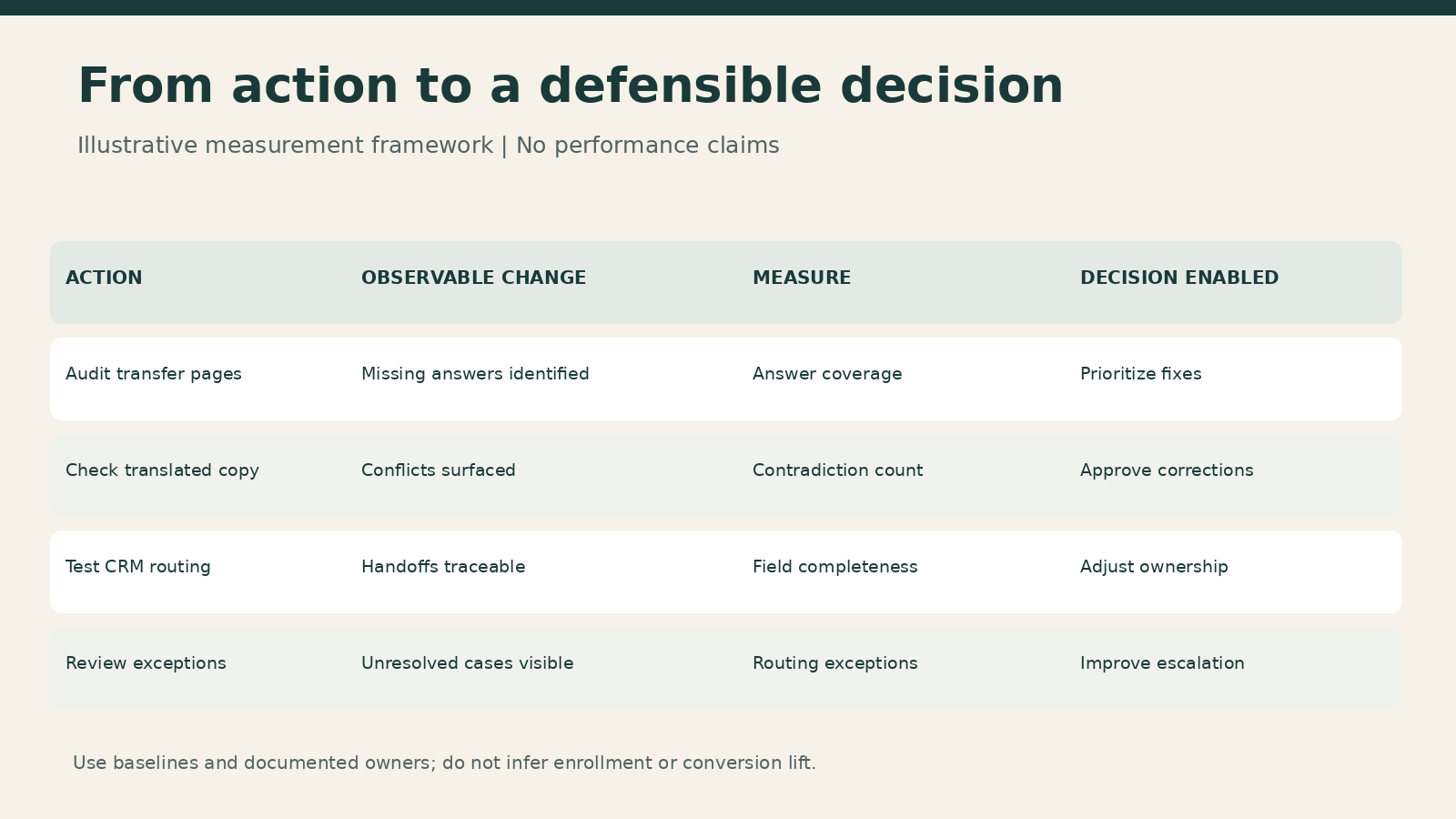
Map priority transfer questions to authoritative owners → see which answers are missing or contradictory → measure verified answer coverage and unresolved cases → decide which pages and scripts need correction.
Test the journey from localized discovery to a transfer inquiry → observe where source or program context disappears → measure field completeness and routing accuracy → decide which forms or CRM mappings require repair.
Review a sample of transfer responses with authorized staff → observe inconsistent explanations or unnecessary handoffs → measure response ownership, elapsed time, and repeat questions → decide where staff guidance needs revision.
Recheck the pathway after the platform configuration is complete → observe differences between expected and actual data flow → measure mapping exceptions and content-version mismatches → decide whether the launch is operationally ready.
The 2027–28 application may be simpler to submit. Whether the decision feels clearer will depend on the university’s own evidence and operations. The most useful preparation is not another transfer slogan. It is an answer a prospective student can verify—and a next step the institution can actually deliver.
Transfer Pathway Readiness
Make your transfer pathway easier to evaluate.
AMB can help your institution review how prospective transfer students encounter eligibility, cost, timing and next-step information across official pages, localized channels and inquiry handoffs. Anyone who contacts AMB may receive, at no cost, a tailored research and strategy overview proposal of up to 20 pages, plus up to one hour of discussion with our team. There is no commitment required. We will offer candid, practical recommendations even if your institution decides not to proceed with AMB. Academic credit and admission decisions remain with your institution.
AMB Insights
Stay ahead of Chinese-speaking market shifts.
Get AMB Insights on Chinese-speaking market intelligence, enrollment strategy, and market-specific enrollment infrastructure.