International Enrollment
The 2026 Midterms and the Next China Recruitment Cycle: The Case for Early Readiness
History offers reasons to watch for a more constructive international education environment. Universities still need a plan for the months before any policy change reaches prospective students.
A review of ten U.S. presidential terms, three policy scenarios, and the digital foundations institutions can build before the next recruitment opportunity.
By AMB Digital | November 4, 2026
On November 3, U.S. voters elected a new Congress. The Associated Press projects that Democrats have won control of both the House of Representatives and the Senate, with some individual races still being counted as of November 4. President Donald Trump remains in office. The next Congress begins its term on January 3, 2027. [1][2]
For universities recruiting internationally, the result creates a reason to revisit planning assumptions. Congressional leadership shapes legislation, appropriations, oversight, and the scrutiny that federal agencies face. Student visa processing, entry requirements, and many day-to-day rules also depend on executive agencies and the courts. These different mechanisms operate on different timelines.
A more favorable policy environment is one plausible outcome over the next two years. Changes could arrive gradually, affect certain groups of students first, or remain tied up in negotiation and litigation. The planning question for institutions is practical: how much China-market readiness can be built now, while the cost remains manageable, so that future opportunities can be acted on quickly?
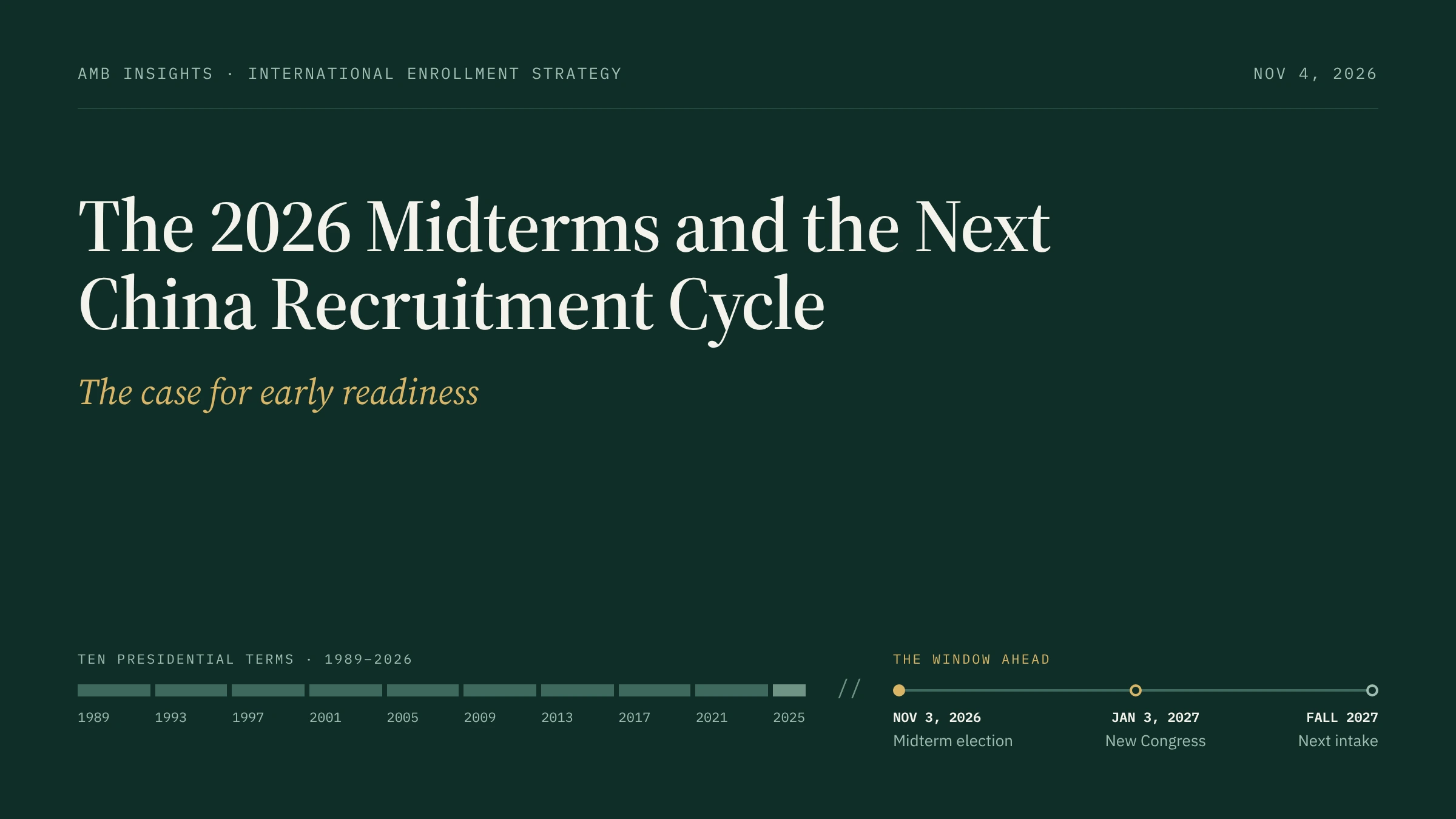
What ten presidential terms tell us about international education
An examination of the five Democratic and five Republican presidential terms from 1989 through the current term gives a useful historical record. It also shows the limits of predicting a specific student visa outcome from an election result alone.
The chronology contains important steps toward international engagement, expanded post-graduation training opportunities, stronger reporting systems, and tighter scrutiny of some applicants. Several of these developments crossed party lines. Each entry below identifies a selected policy action during a specific presidential term.
| Presidential term | Selected measure affecting international education | Practical significance |
|---|---|---|
| George H. W. Bush, Republican (1989–1993) | Executive Order 12711 (1990) provided protections for certain Chinese nationals already in the U.S., following events in China in 1989. [3] | A Republican administration took a significant protective action involving Chinese students and scholars. |
| Bill Clinton I, Democratic (1993–1997) | The 1996 immigration law initiated a federal requirement to collect information on international students and exchange visitors. [4] | Student monitoring requirements also developed under Democratic leadership. |
| Bill Clinton II, Democratic (1997–2001) | The 2000 Memorandum on International Education Policy called for a coordinated approach to attracting and educating students from abroad. [5] | International education received an explicit national policy endorsement. |
| George W. Bush I, Republican (2001–2005) | SEVIS became mandatory for new students and exchange visitors in 2003. [6] | Institutions faced stronger reporting and compliance obligations. |
| George W. Bush II, Republican (2005–2009) | A 2008 regulation introduced a 17-month STEM OPT extension for eligible graduates. [7] | Certain international graduates gained additional time for practical training. |
| Barack Obama I, Democratic (2009–2013) | DHS expanded the list of STEM degrees eligible for the existing OPT extension in 2011 and 2012. [8] | Additional academic programs became eligible for a post-graduation pathway. |
| Barack Obama II, Democratic (2013–2017) | A 2014 U.S.–China arrangement extended the validity of qualifying F/M/J visas to up to five years; a 2016 rule replaced the 17-month STEM OPT extension with a 24-month extension. [9][10] | Travel flexibility and eligible post-graduation training opportunities expanded. |
| Donald Trump I, Republican (2017–2021) | Proclamation 10043 (2020) restricted entry for a defined group of Chinese graduate students and researchers with specified affiliations, subject to exceptions. [11] | Security-based restrictions affected particular categories of applicants. |
| Joe Biden, Democratic (2021–2025) | A 2021 federal joint statement supported international education; DHS added 22 qualifying fields to the STEM degree list in 2022. [12][13] | Public support and targeted eligibility expansion formed part of the policy record. |
| Donald Trump II, Republican (2025–present) | Student and exchange visa applicants became subject to expanded online-presence vetting; a 2026 final rule seeking to replace duration of status with fixed admission periods has been blocked by a federal court while litigation continues. [14][15] | Increased scrutiny and legal uncertainty remain relevant to recruitment planning. |
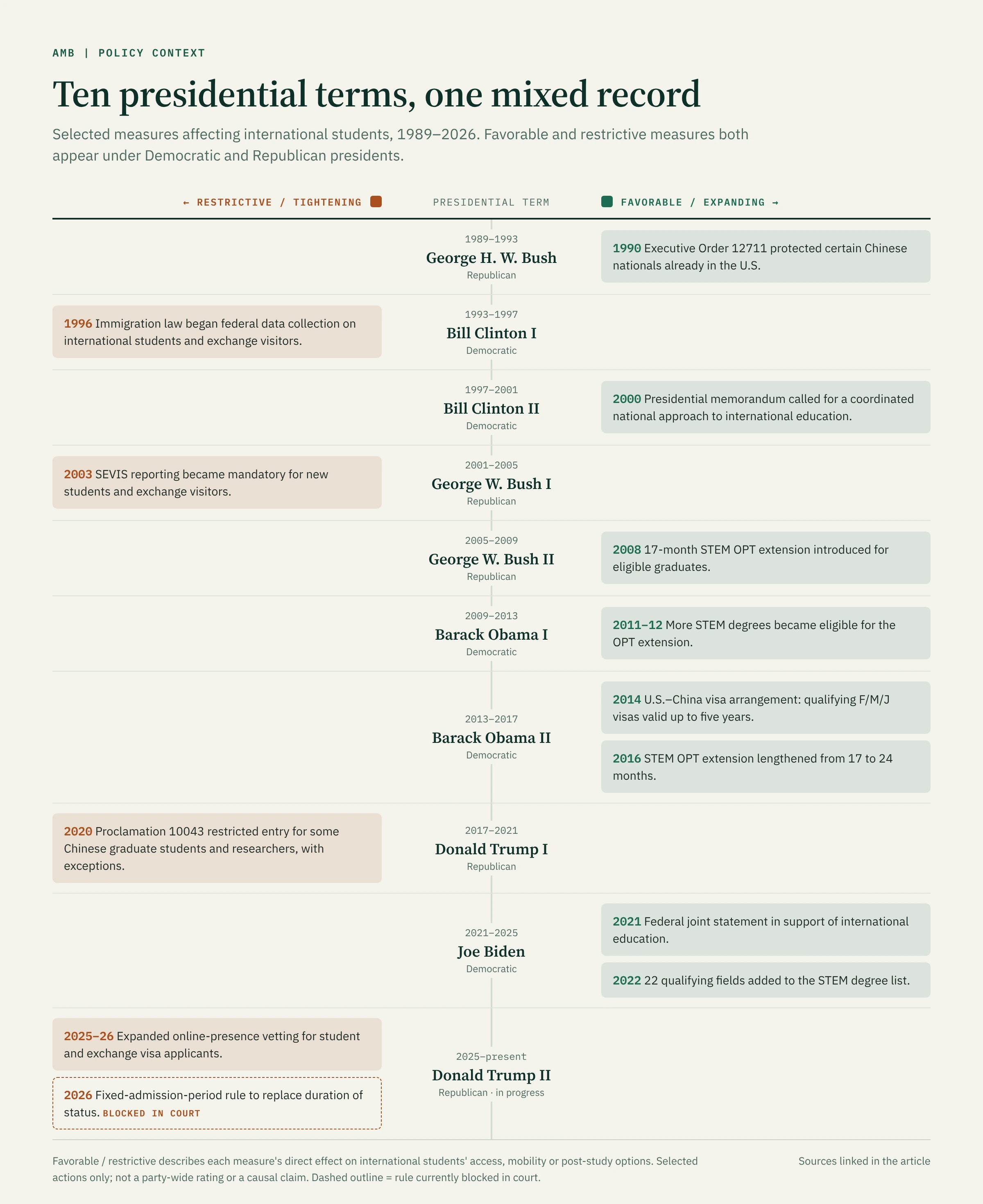
The history supports two useful observations. The recent Democratic administrations of Clinton, Obama, and Biden established identifiable initiatives in support of international education or expanded eligibility for some students. Republican administrations have also enacted meaningful student-friendly measures, including the 2008 STEM OPT extension and protections for Chinese nationals in 1990. Compliance and security measures developed under both parties.
This record gives institutions legitimate grounds to monitor potential improvements after the 2026 midterms. It offers no reliable numerical estimate of the probability of a visa-policy change. The current election changed congressional control while the presidency and federal agencies remain under the existing administration.
The mechanisms matter as much as the headlines
Congress can shape the operating environment through legislation, appropriations, confirmation of nominees, hearings, and oversight. A Democratic majority may increase scrutiny of existing immigration measures and create room for proposals more supportive of international education. The president retains substantial authority over executive policy and the veto. Agency rulemaking has its own procedures. Courts can delay or invalidate rules.
A current example illustrates the timing issue. DHS published a final rule in July 2026 to replace the longstanding duration-of-status framework for many F and J nonimmigrants with fixed admission periods. A federal court issued nationwide preliminary relief on September 14, blocking implementation. As of this article’s publication date, the rule remains blocked while litigation continues. [15]
For a prospective student, the practical experience may be shaped by consular appointments, document review, university guidance, and individual eligibility well before a legislative proposal becomes law. Schools have limited control over federal decisions. They have substantial control over the quality, timeliness, and accessibility of their own information.
The China market is large, even as the indicators diverge
China remains an important origin market for U.S. higher education. IIE’s Open Doors 2025 counted 265,919 students from China in academic year 2024/25, down approximately 4% from the preceding year. That figure covers students already enrolled and those in optional practical training as defined by the survey; it should not be read as a count of new applicants. [16]
Other indicators are more cautionary. Common App reported a 10% decrease in international first-year applicants during the 2025–26 application season among its participating institutions. The platform’s applicant figures are a different population and period from Open Doors enrollment data. [17] In August 2026, NAFSA published a scenario analysis projecting as many as 111,000 fewer international students in fall 2026 and up to $3.4 billion in associated economic impact. Those are projections, not final enrollment outcomes. [18]
Together, these signals support targeted planning. Institutions need their own China-specific funnel data: inquiries, applications, admits, deposits, arrivals, and enrollment. Broad national trends can reveal pressure across the sector. The appropriate investment decision depends on each institution’s programs, price point, audience, enrollment capacity, and current visibility in Chinese-language channels.
Three scenarios for the next recruitment cycle
The following scenarios are planning tools. They describe possible developments, without attaching probabilities or predicting the next federal policy decision.
Scenario 1 — Meaningful improvement
Congressional action, administrative adjustments, or successful legal challenges create a more workable environment for some international students. Possible improvements could involve clearer processing guidance, a more predictable entry framework, or greater confidence in post-completion pathways. Each would require its own legal or administrative basis.
For schools, this could create a window for increased inquiries or stronger conversion among applicants who were already considering the United States. A university with reliable Chinese-language information, working inquiry channels, and a calendar of relevant content could respond within days. Institutions beginning from an empty digital presence would need to establish accounts, create accurate materials, test their workflow, and build a baseline of discoverability.
Scenario 2 — Selective or gradual improvement
Oversight increases and some disputes are resolved, while many visa and administrative requirements remain in place. Different student groups and academic programs experience different practical outcomes. Policy updates could arrive over several months through separate agency decisions and court proceedings.
This is an especially useful scenario for budget planning. A college can maintain a modest Chinese-language presence and improve its information architecture without committing to a large recruitment campaign. The institution gains a more reliable channel for communicating confirmed changes when they occur and for addressing recurring questions during the application cycle.
Scenario 3 — Continued friction
Congress and the administration remain divided over immigration policy. Consular screening practices continue, and uncertainty persists around some categories of students. Additional legal challenges or agency actions extend the period of adjustment.
In this environment, outreach spending may need tighter controls, particularly for programs exposed to visa or post-graduation uncertainty. Accurate program information, transparent cost explanations, properly sourced policy updates, and responsive inquiry handling retain practical value. Institutions should measure whether their digital work is reaching a viable audience before expanding paid promotion.
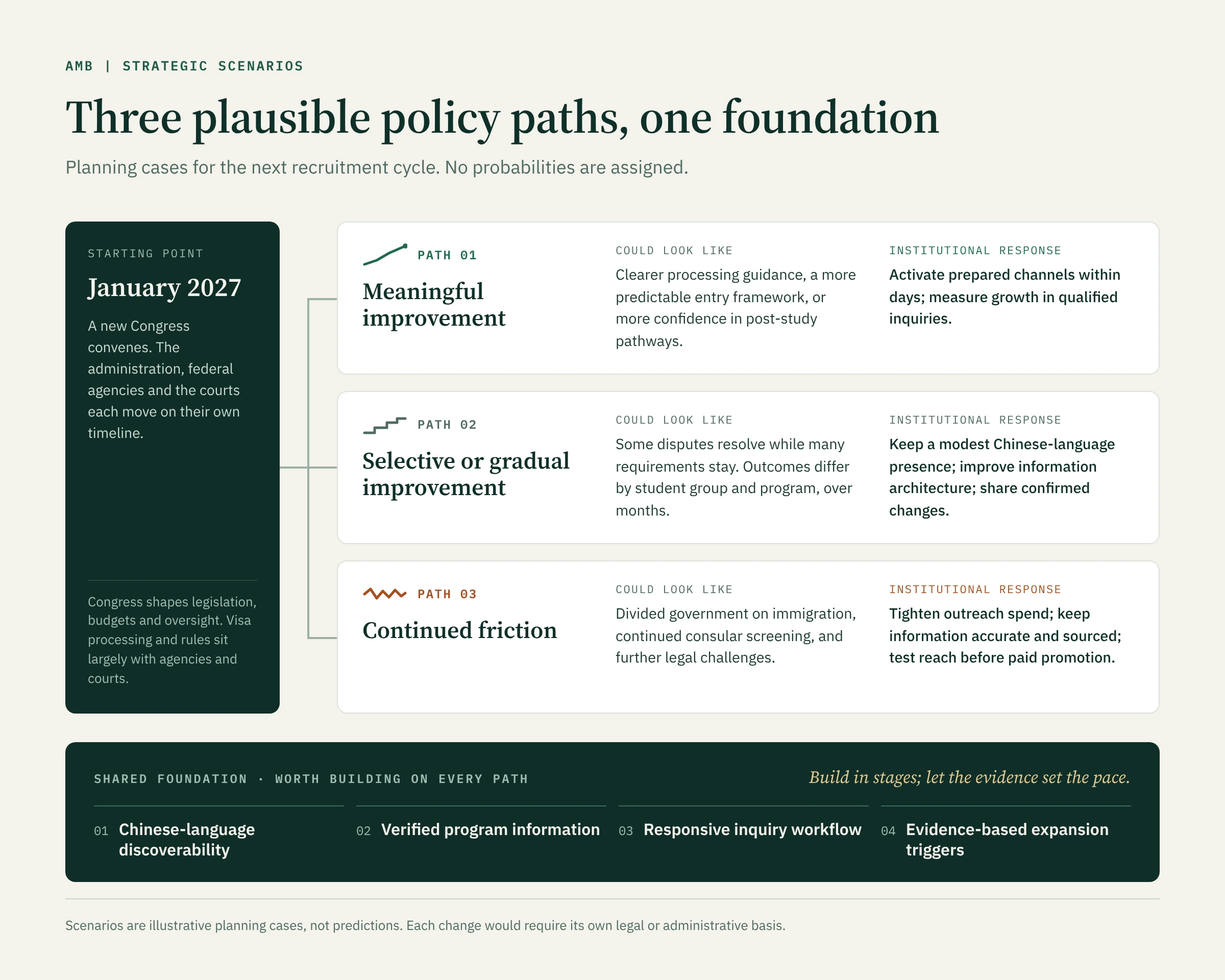
A common operational lesson runs through all three scenarios: the foundation can be built in stages, and the pace of expansion can follow the evidence.
The advantage of starting early is operational
A school entering Chinese-language digital channels has several tasks that take time independently of federal policy. Its programs must be represented accurately. Chinese-language names and descriptions need to be consistent across platforms. Prospective families need a credible way to determine which accounts and information are official. Questions have to reach a person who can provide a timely answer. The institution needs a method to tell useful engagement from activity that never reaches admissions.
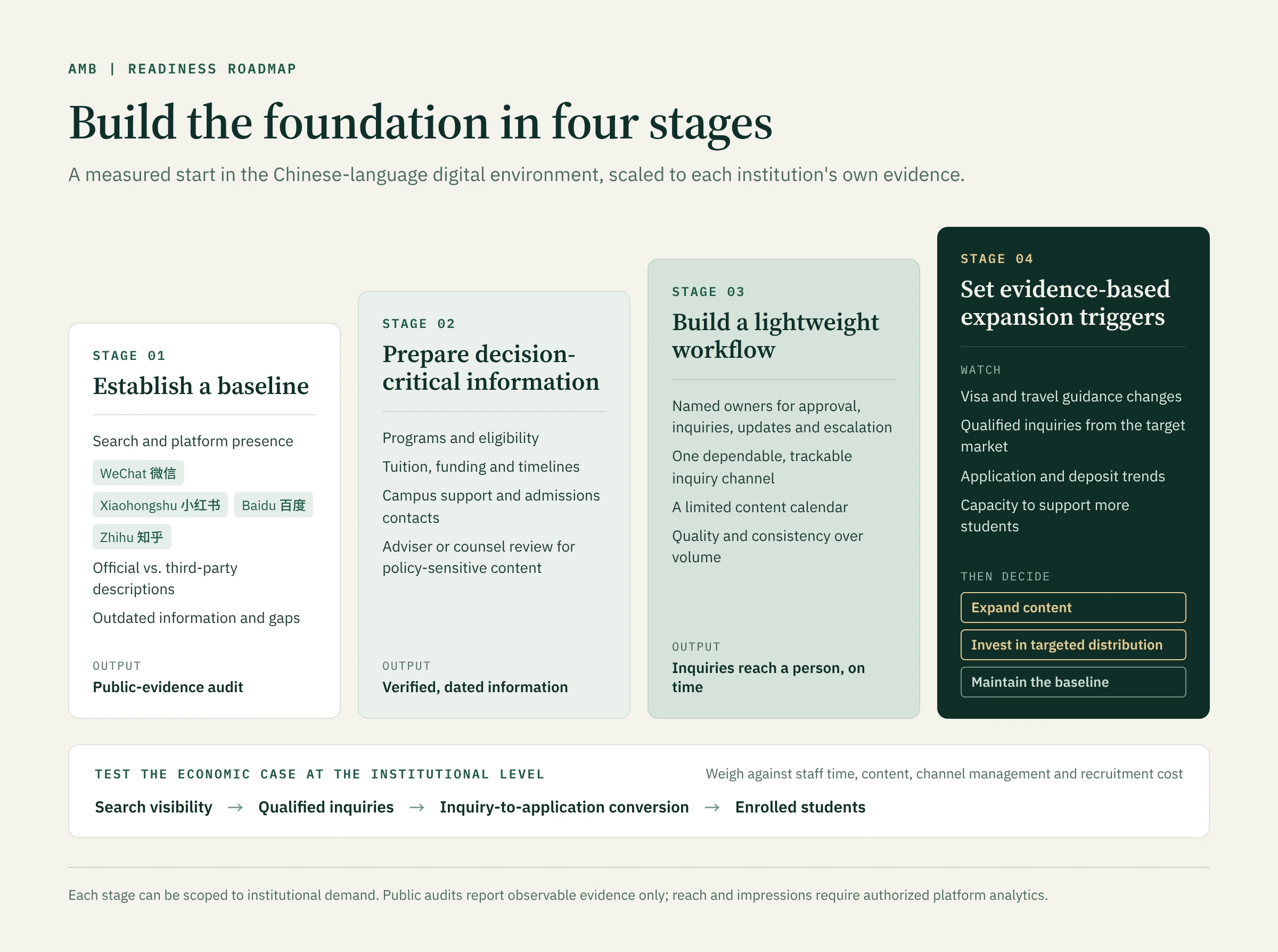
A measured readiness program could follow four steps:
1. Establish a baseline. Review how the institution appears in Chinese-language search and on relevant platforms such as WeChat, Xiaohongshu, Baidu, and Zhihu. Identify existing official accounts, third-party descriptions, outdated information, and important gaps. Publicly available evidence can support a baseline audit; account-level impressions and reach require authorized access to platform analytics.
2. Prepare the information that affects decisions. Prioritize program and eligibility explanations, tuition and funding information, application timelines, campus support, and admissions contacts. Create a process for reviewing policy-sensitive content with the institution’s designated international student advisers or counsel when necessary. Families should be able to identify the most recent confirmed information.
3. Build a lightweight communication system. Assign ownership for content approval, Chinese-language inquiries, updates, and escalation. Make contact paths visible and trackable. A small institution can begin with a limited content calendar and one dependable inquiry channel. Quality and consistency matter more at this stage than publication volume.
4. Set evidence-based expansion triggers. Monitor relevant developments and connect them to a decision framework: changes in visa or travel guidance, qualified inquiries from the target market, application and deposit trends, and the institution’s ability to support additional students. Set thresholds for deciding whether to expand content, invest in targeted distribution, or maintain the baseline.
An institution may also serve Chinese-speaking families already living in the United States. That segment has its own needs and admissions pathways. A Chinese-language information foundation can support both audiences, provided messaging, eligibility details, and measurement are separated appropriately.
The economic case should be tested at the institutional level. Useful measures include visibility for priority school and program searches, qualified inbound inquiries, inquiry-to-application conversion, and eventual enrolled students. Schools should compare those outcomes with the full cost of staff time, content production, channel management, and recruitment. Revenue or enrollment gains cannot be assumed from the existence of a new account alone.
A practical decision for the months ahead
The next Congress begins in January 2027. Many institutional recruitment decisions will be made sooner, alongside application deadlines, spring travel plans, and planning for fall 2027 and beyond. A university that wants to benefit from an improving environment can decide now which assets are worth building under several possible outcomes.
A modest digital foundation preserves options. It reduces the setup work required for a future campaign, improves access to verified information today, and creates a clearer basis for determining whether a larger investment is justified. The size of that investment should reflect the institution’s own evidence and ambitions.
The next recruitment opportunity may arrive before a school has finished preparing for it. Early readiness gives institutions a chance to set their own pace.
Sources and scope
The historical review covers five Democratic and five Republican presidential terms beginning in 1989; the second Trump term remains in progress. Selected actions illustrate policy development during each term. The article does not establish a causal connection between party control and subsequent enrollment outcomes. Election status is based on reporting available November 4, 2026, and may be updated as vote counting continues.
China Digital Presence Audit
How visible is your institution in the Chinese-language digital environment?
AMB Digital offers a complimentary China Digital Presence Audit for institutions considering their next steps. The initial review examines publicly observable search visibility, official and third-party content, relevant public conversations, and gaps in information that prospective students and families may encounter.
The audit is intended to start a practical discussion about readiness and priorities. It does not require an institution to commit to a full recruitment campaign. Where analytics or enrollment data are unavailable, findings are labeled as public observations. We do not assign unverified impressions, reach, or conversion figures.
Request a complimentary audit through AMB’s contact page. Mention “China Digital Presence Audit” when you get in touch.
AMB Insights
Stay ahead of Chinese-speaking market shifts.
Get AMB Insights on Chinese-speaking market intelligence, enrollment strategy, and market-specific enrollment infrastructure.