China Market
A U.S. Degree Without Leaving China?
China-based U.S.-linked degrees are changing recruitment competition. A practical audit helps universities clarify the value of studying on campus.
American universities recruiting in China are no longer competing only with other campuses abroad. They are also competing with programs that let students stay in China while still earning some form of U.S.-linked credential.
That matters because the product itself is changing. For many families, the question is no longer simply whether to study in the United States. It is whether leaving China is still necessary to get what they want from a U.S. university.

On October 8, 2026, Clark University announced a new dual-degree program with Hefei University of Technology (HFUT) and its inaugural cohort of 100 students. It combines HFUT’s Digital Economy degree with Clark’s B.S. in Finance. Clark’s partnership page describes a 4+0 model without required coursework on its U.S. campus. HFUT’s announcement confirms that both awards depend on meeting the respective institutions’ academic requirements. This is distinct from their older International Economics and Trade collaboration; that program’s approval does not establish the new degree arrangements.
A week later, Shenandoah University announced 170 newly admitted students in its Yangtze Normal University dual-degree programs. Shenandoah describes its degrees as Engineering Physics and Computer Engineering. Yangtze Normal’s 2026 admissions charter names the Chinese majors Robotics Engineering and Intelligent Manufacturing Engineering. These are institution-specific program names within the partnership. The charter specifies 4+0 study delivered in China; students may receive the corresponding Shenandoah degree only if they also meet Shenandoah’s degree-awarding requirements.
On the same day, Shenandoah reported nearly 140 new students in its separate Henan College of Transportation program: a three-year Chinese junior-college diploma and Shenandoah EIET certificate arrangement, not a U.S. bachelor’s degree program. None of these cohort figures is a U.S.-bound enrollment total.
China-based cooperative programs and direct recruitment to a U.S. campus often use different admissions systems and offer different educational experiences. These announcements demonstrate additional pathways, not a nationwide shift, measured losses from U.S. campuses, a causal effect on international enrollment, or a preference shared by all Chinese students.
The important detail is that these offers are not all the same. Degree type, awarding institution, study location, admissions route, tuition, and delivery requirements need separate verification.
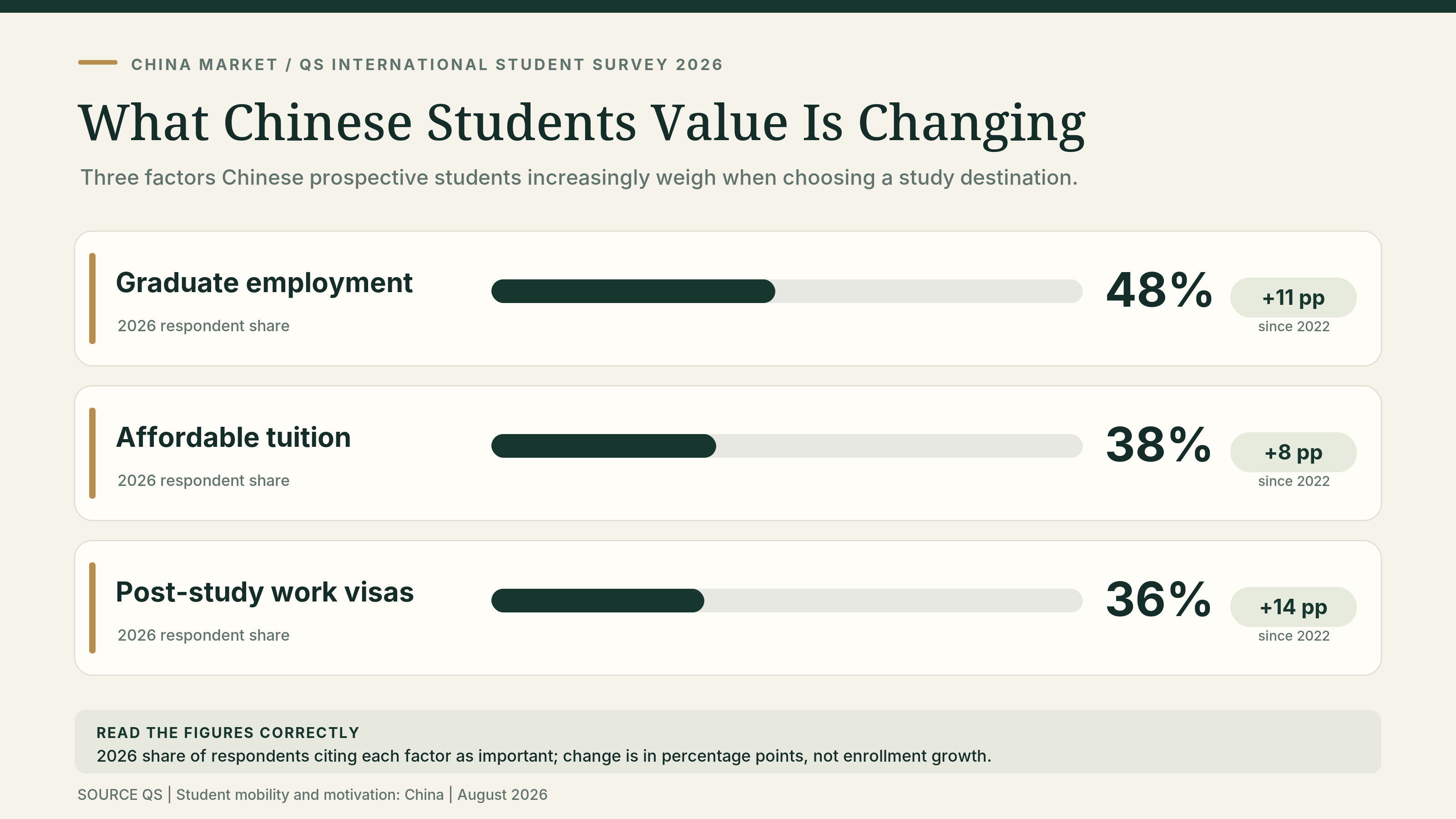
QS’s 2026 China research reports graduate employment opportunities at 48% of respondents, up 11 percentage points since 2022; affordable tuition at 38%, up 8 points; and post-study work visa opportunities at 36%, up 14 points. These figures measure reported importance among survey respondents, not employment, visa approval, or enrollment outcomes. Families are asking what they get, where they study, and what follows graduation.
That changes the recruitment challenge. Institutions need to explain why their U.S. campus experience is worth the additional cost, distance, and uncertainty, with evidence rather than reputation alone.
For AMB, this points to a practical piece of work: a China pathway competition audit.
Start with four questions.
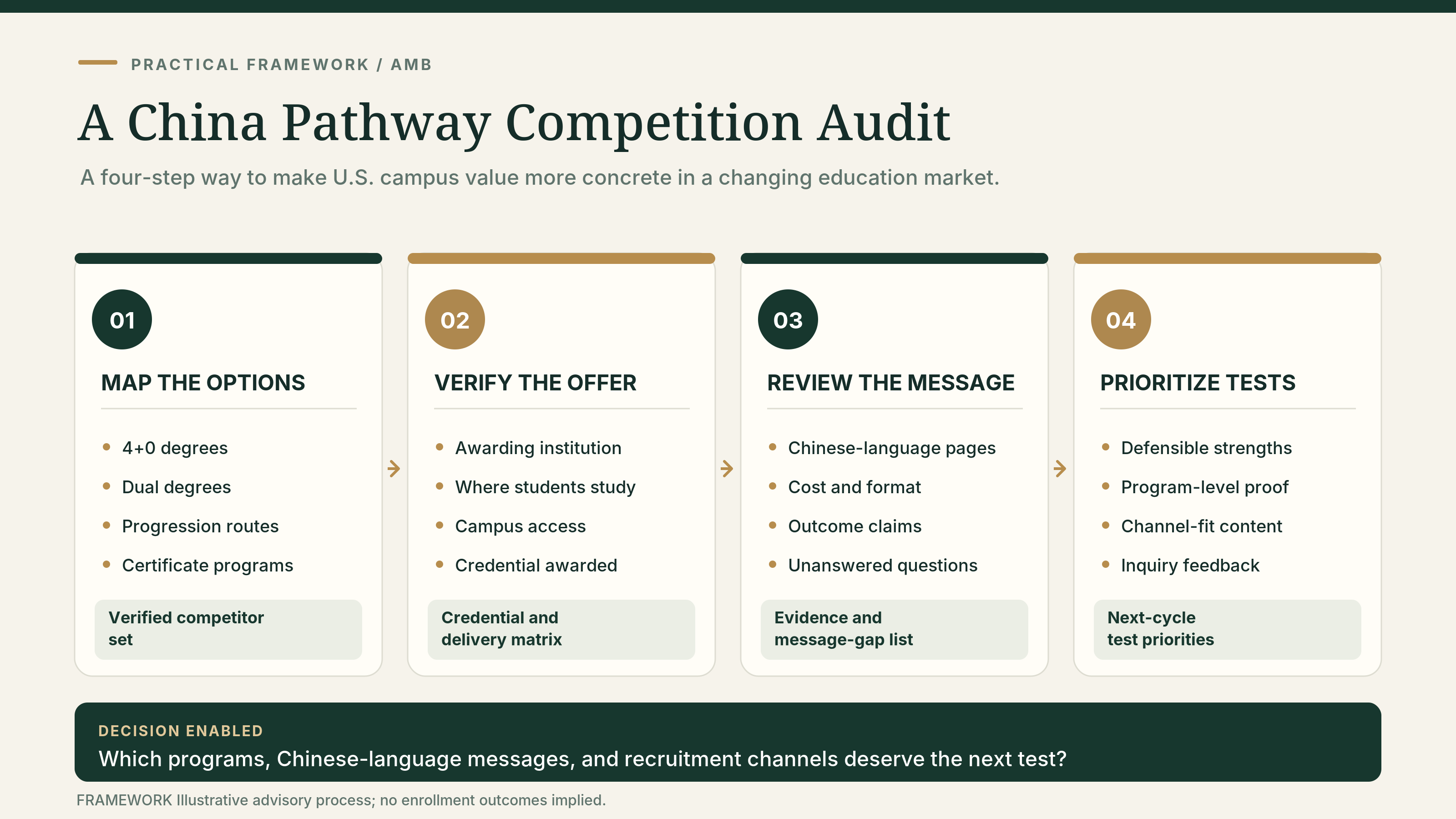
First, which programs are relevant alternatives? Identify universities and specific dual-degree, 4+0, progression, and certificate pathways; record the number of verified competing pathways.
Second, what does each offer actually provide? Verify credentials, awarding institutions, admissions routes, study locations, tuition, and teaching arrangements against authoritative sources. Track unresolved credential-information gaps.
Third, how does your Chinese-language messaging compare? Assess content clarity and evidence for campus-based value: research access, faculty interaction, campus community, career services, or internships. Record recurring prospect questions rather than assuming what all families want.
Fourth, which program-level recruitment tests deserve priority? Test clearer credential comparisons and supported campus-value messages through appropriate channels. Use inquiry feedback and recurring questions to assess whether explanations resolve uncertainty.
The goal is not to copy 4+0 programs or assume students prefer staying home. It is to compare educational propositions and make your university’s value clear.
Map pathways and messaging → identify missing facts and weak explanations → measure verified pathway coverage, unresolved gaps, content clarity, recurring questions, and inquiry feedback → decide which programs, messages, and channels to test next.
When “study in the U.S.” is no longer the only way to access a U.S.-linked credential, institutions need to explain carefully what their campus-based experience is worth.
China Pathway Competition Audit
Make your U.S. campus value clearer in China.
AMB can help your institution compare China-based U.S.-linked degree pathways, verify competing credentials and delivery models, and identify where your Chinese-language recruitment message needs stronger evidence.
Institutions that contact AMB may receive a tailored research and strategy overview proposal of up to 20 pages at no cost, together with up to one hour of discussion with our team. There is no commitment required. We will offer candid, practical recommendations whether or not you decide to work with AMB.
AMB Insights
Stay ahead of Chinese-speaking market shifts.
Get AMB Insights on Chinese-speaking market intelligence, enrollment strategy, and market-specific enrollment infrastructure.