International Enrollment
Turn In-Country Recruitment Into a Market Feedback Loop
In-country teams hear what students, families, counselors, and agents are telling you. A market feedback loop turns those signals into better content, CRM handoffs, and enrollment decisions.
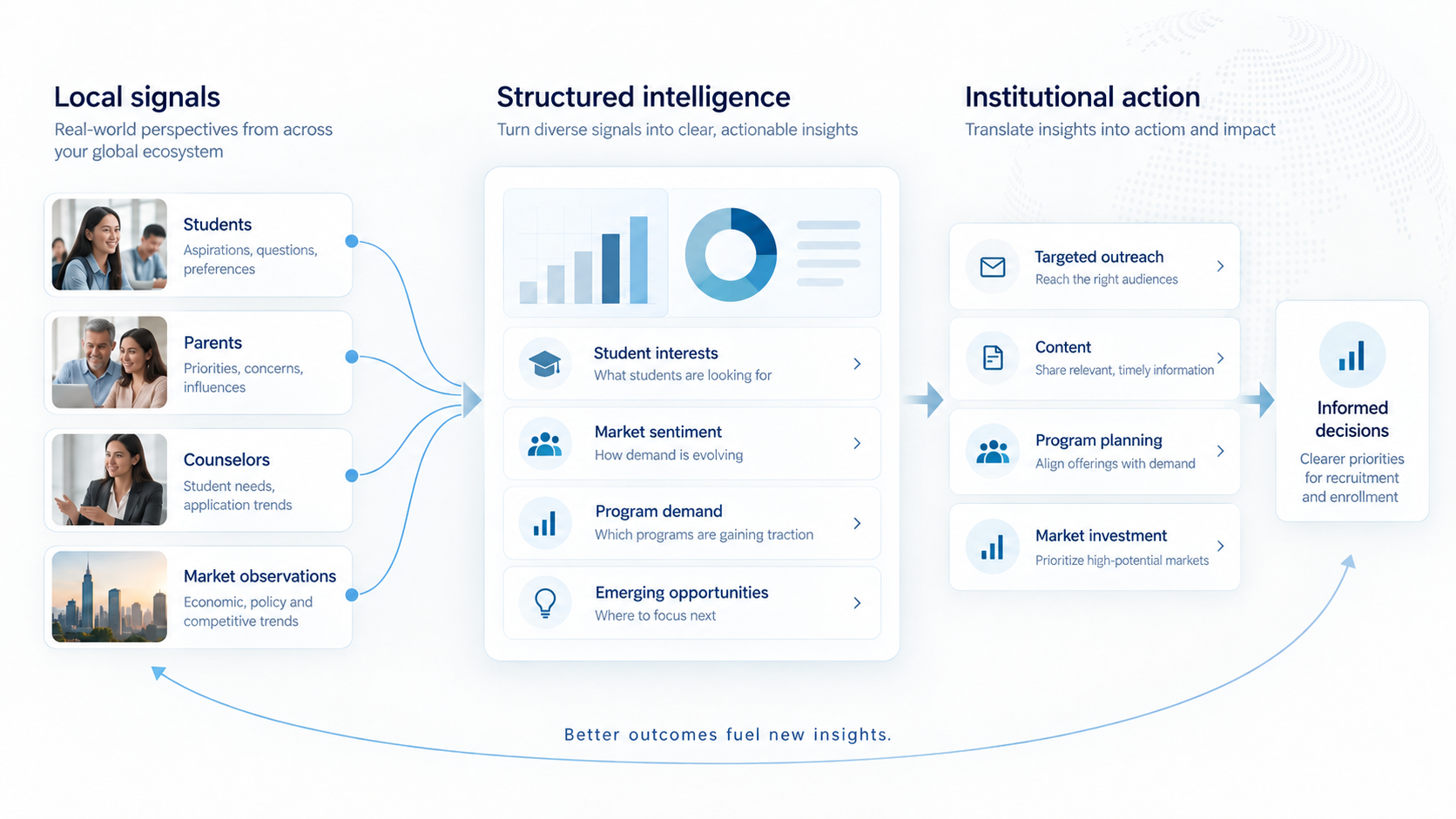
International recruitment teams are putting more people closer to the markets they serve.
A representative who works in-market can hear the questions that never appear in a dashboard: why a family removed a university from the shortlist, which scholarship is being misunderstood, which competitor suddenly dominates counselor conversations, or why a program that looked promising from headquarters is not landing locally.
AIRC brought that issue into focus on September 8 with a webinar on building and supporting overseas recruitment teams, based on original survey research with in-country representatives across source markets and study destinations.
An in-country team can become a continuous source of market intelligence—if the institution has a way to use what the team learns.
Your local team sees what the dashboard misses
Current university roles already reflect this broader expectation. A 2026 University of Glasgow China-based recruitment role includes market research, trend analysis, horizon scanning, reporting, social and digital activity, agent training, and maintenance of overseas recruitment databases.
It arrives as repeated questions from parents. A counselor comment after an event. A sudden shift in program interest. A competitor message that keeps appearing. Confusion about price, outcomes, housing, or application requirements. A social platform pattern that headquarters cannot easily see.
If they stay inside weekly calls, travel notes, messaging threads, or one person’s memory, the institution has local activity but very little institutional learning. The work begins with market infrastructure, not another isolated activity report.
Turn repeated signals into shared intelligence
Give the in-country team a question set. Instead of asking only for activity counts, define what the institution wants to learn: changing program interest, family concerns, price sensitivity, competitor movement, counselor feedback, application friction, and channel behavior.
Capture recurring signals consistently. Use a small shared taxonomy so the same issue is recorded the same way across weeks, cities, events, and team members.
Turn signals into institutional action. A recurring question may belong in a landing page, counselor toolkit, webinar, parent FAQ, admissions email, staff briefing, or localized campaign. A recurring objection may require a different proof point rather than more promotion.
Preserve the context when an inquiry moves. If a prospect enters the CRM, the admissions team should not lose the market, source, event, language, or conversation context that made the inquiry meaningful.
Review what changed. Once a month, bring the strongest signals to the people who can change content, outreach, inquiry handling, program emphasis, and market investment. Market-specific learning matters precisely because markets do not move in one uniform direction.
That is the loop:
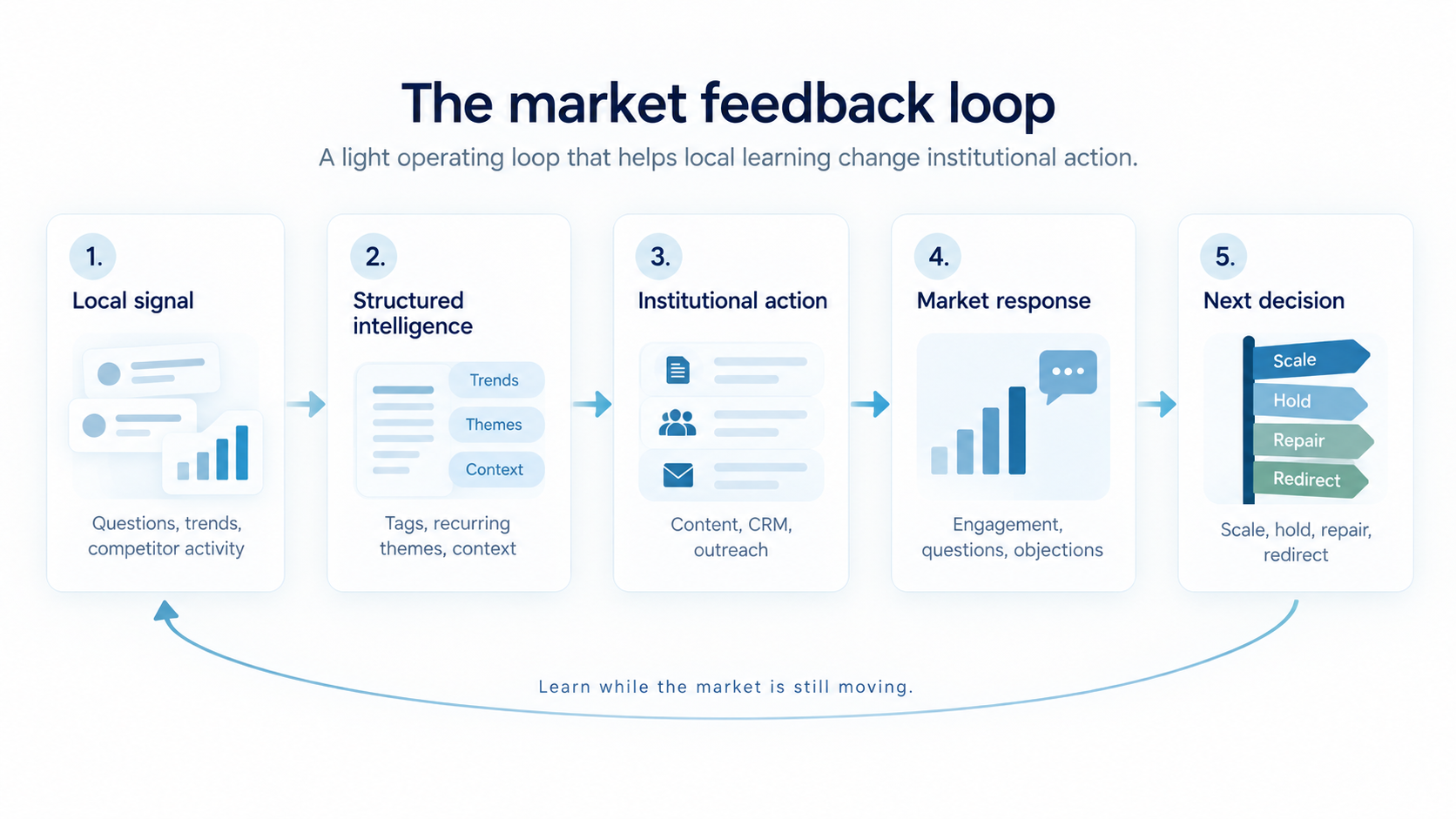
Local signal → structured intelligence → institutional action → market response → next decision.
Keep the system light enough that the local team will actually use it. The goal is not to turn recruiters into researchers or add another reporting burden. A small number of consistent fields, a place for qualitative context, and a clear route to action are more useful than a long template nobody trusts. In fragmented information environments, the local context behind discovery can be as important as the activity count.
Measure whether the learning is moving
Create a shared signal taxonomy → repeated market observations become visible across the team → measure recurring themes and reporting consistency → decide which issues require action.
Connect repeated questions to owned content → students, families, counselors, and agents receive clearer official answers → measure content changes, repeated-question volume, and unresolved gaps → decide what should be expanded, localized, or retired.
Preserve market context through inquiry handoff → admissions receives more usable information about why a prospect engaged → measure source completeness, ownership, and follow-up quality → decide where routing or response needs repair.
Run a monthly market review → local evidence reaches enrollment leadership on a predictable cadence → record actions, owners, and follow-up decisions → decide whether to scale, hold, repair, or redirect the institution’s market investment.
In-country recruitment already gives institutions something valuable: proximity.
When local questions can change institutional content, when market signals survive the CRM handoff, and when leadership can see what the market is teaching the institution, the team is doing more than recruiting.
It is helping the institution learn while the market is still moving. See how AMB works when local presence needs to connect to the institutional enrollment operation.
In-Market Operations
See what your local market is telling you—and where that insight gets lost.
If you are evaluating an in-country team, market partner, or localized enrollment operation, AMB can prepare a tailored research and strategy overview of up to 20 pages at no cost. We will also spend up to one hour discussing the findings with your team. There is no commitment required, and we will provide candid, practical recommendations whether or not you decide to work with AMB.
AMB Insights
Stay ahead of international enrollment shifts.
Get AMB Insights on international enrollment strategy, China-market intelligence, and market-specific enrollment infrastructure.