International Enrollment
China Enrollment Is Down. Applications Are Holding. What Should Universities Believe?
These measures cover different populations and periods. They are not three stages of a conversion funnel, and we cannot use them to calculate how many Chinese applicants eventually enrolled.
November 21, 2026 | International Enrollment
Three recent indicators appear to tell different stories about China.
Open Doors 2026 reports 254,458 Chinese students in the United States in 2025/26, down 4.3% from the previous academic year. Common App’s November 1 update shows 12,879 applicants with Chinese citizenship in the 2026–27 first-year cycle, down just 1% at that point. Meanwhile, IIE’s China fact sheet reports that F-category visas issued to Chinese nationals fell 28.8% between fiscal 2024 and fiscal 2025.
Which figure should an enrollment leader trust?
We take all three seriously. But we would not use them interchangeably—or treat any one of them as a complete picture of Chinese student demand.
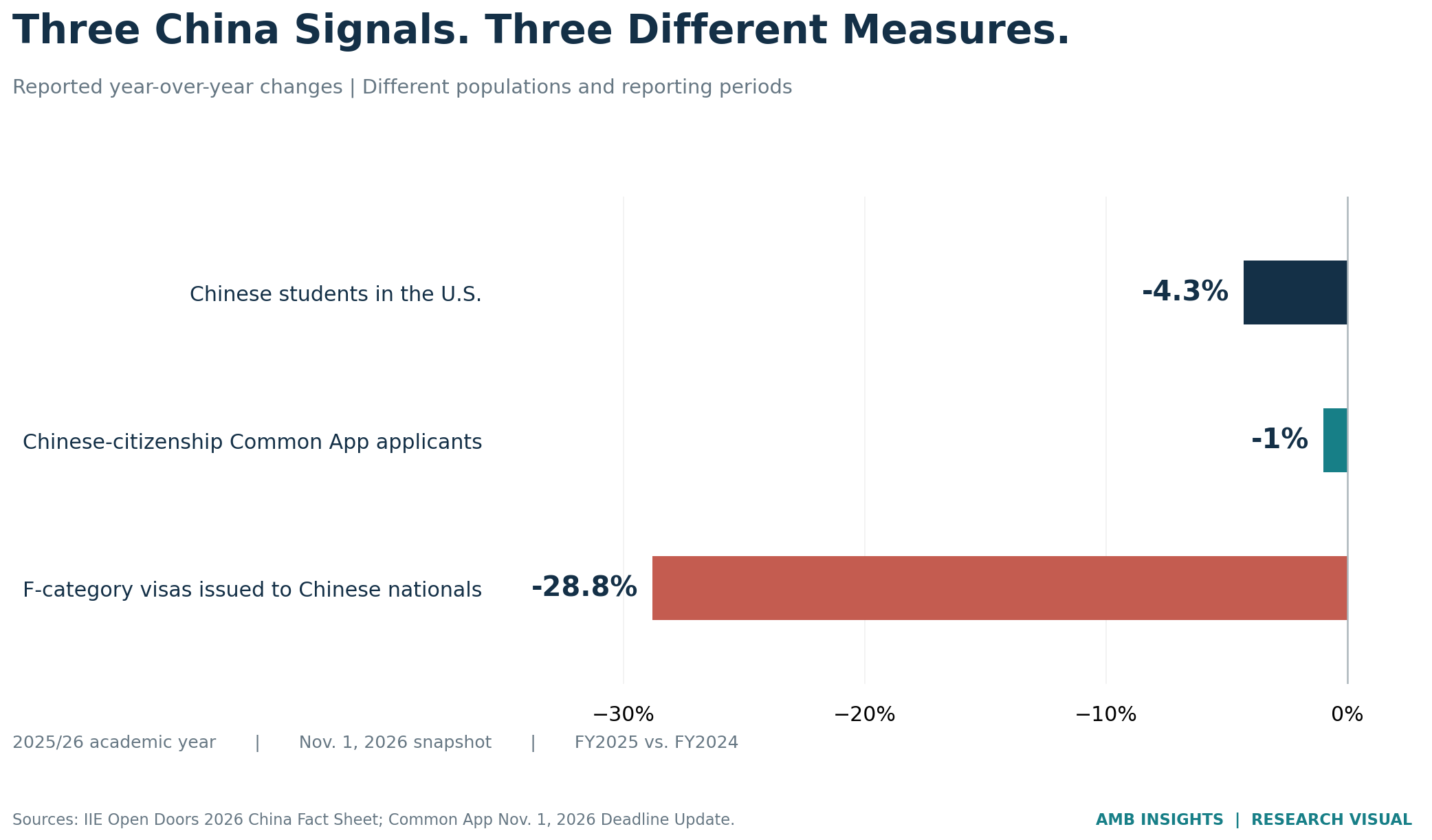
Three indicators, three different measures
Open Doors describes students already in the United States, including those at different academic levels and on Optional Practical Training. It does not measure how many new Chinese students arrived this fall.
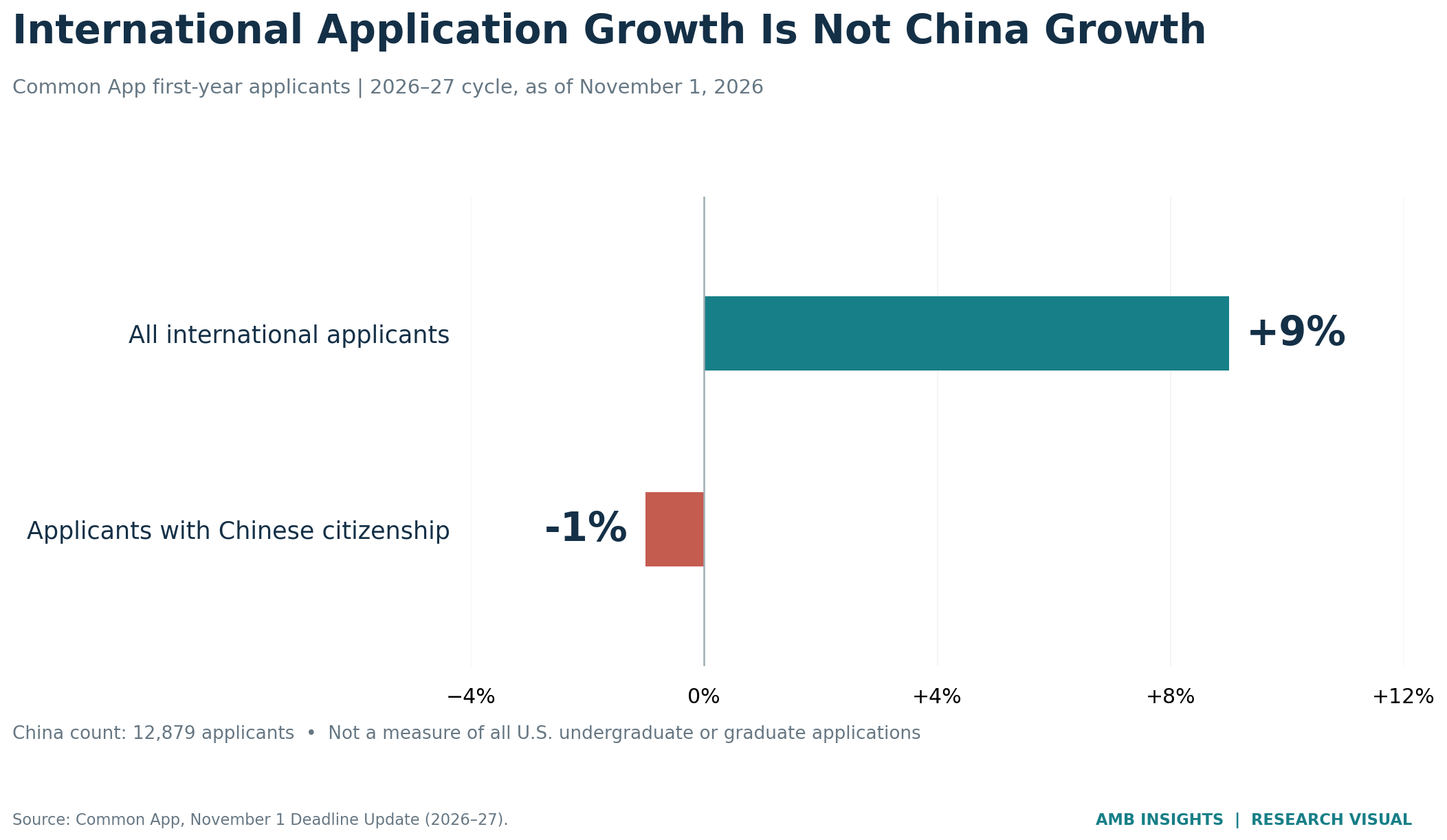
Common App captures an earlier stage: students who submitted applications through its undergraduate platform by November 1. International applicants overall increased 9%, but that is not a China growth rate. Chinese-citizenship applicants were down 1%. The data excludes institutions outside the platform and graduate admissions.
Visa data measures something else entirely. The reported 28.8% decline covers F-category visas, not F-1 visas alone, and compares two fiscal years ending in 2025. Visa issuances cannot be equated with unique student arrivals or actual enrollment.
These measures cover different populations and periods. They are not three stages of a conversion funnel, and we cannot use them to calculate how many Chinese applicants eventually enrolled.
National trends do not explain an individual university’s results
China remains the second-largest place of origin in Open Doors. Within that population, undergraduate enrollment fell 5.1%, graduate enrollment fell 5.1%, and OPT participation declined 0.7%.
IIE’s preliminary Fall 2026 Snapshot adds a more recent observation: participating institutions reported a 15% decline in new international enrollment overall. That figure is not China-specific.
We see a practical problem with using these national figures to make institutional budget decisions. They cannot tell us whether a particular university has fewer qualified Chinese applicants, weaker enrollment yield, documentation delays, or simply too little information reaching prospective families.
Consider two universities. One receives roughly the same number of Chinese undergraduate applications but sees fewer students arrive. Another loses inquiries for one graduate program while interest in another remains steady.
These are illustrative scenarios, not reported institutional results. We would investigate them differently rather than prescribe the same recruitment response.
What we would examine before changing recruitment investment
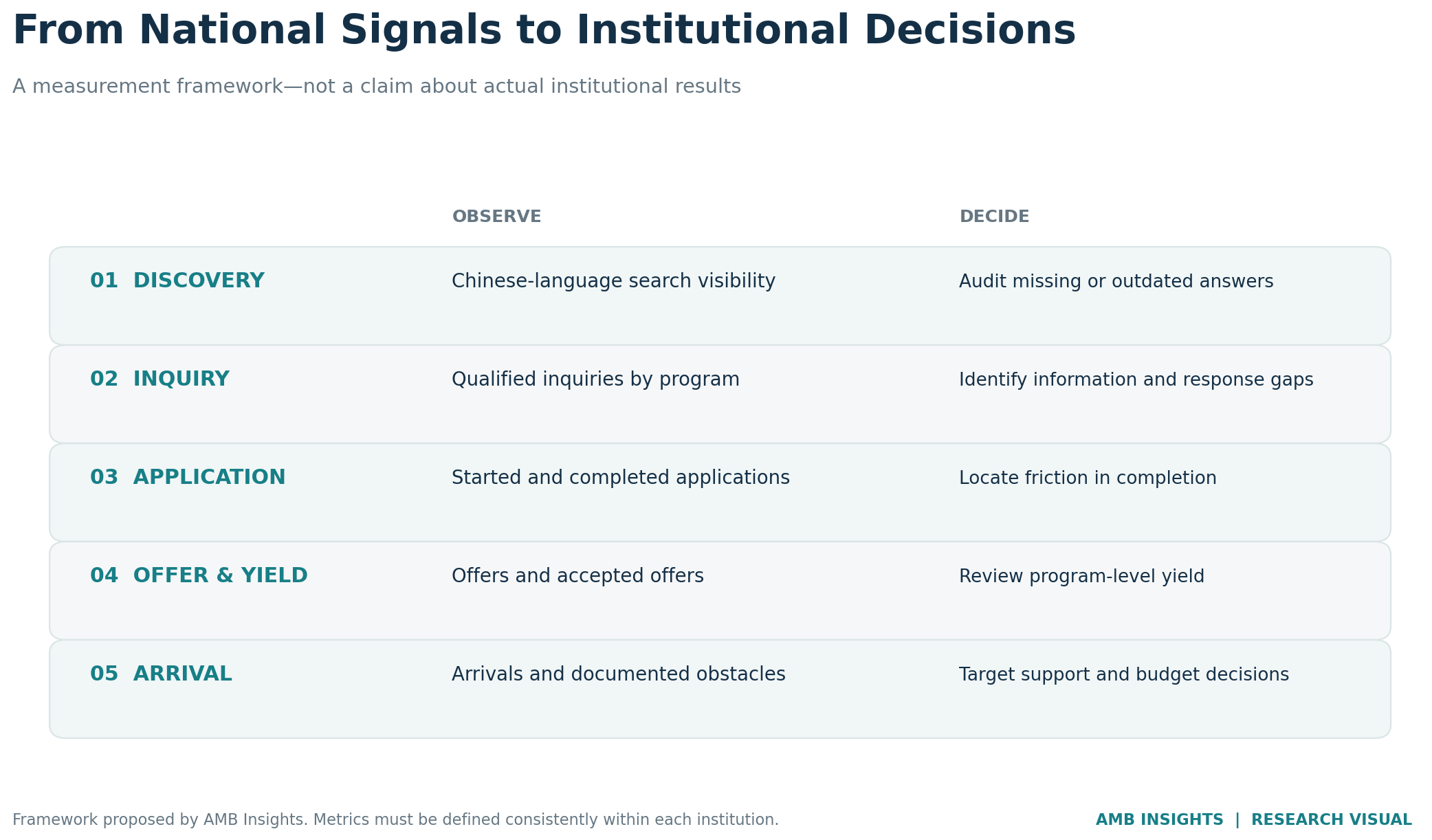
We recommend beginning with the institution’s own evidence, organized around the decisions its enrollment team needs to make.
Understand which students are being reached. We would separate undergraduate and graduate audiences, with program-level analysis where appropriate. Students applying from mainland China and Chinese-speaking families already living in the United States also deserve separate attention.
Follow applications through to enrollment. We would examine discoverability, qualified inquiries, completed applications, offers, acceptances, documented barriers, and actual arrivals. Each measure needs consistent definitions and comparable reporting periods. Social media engagement should never be counted as an application.
Review what families actually find online. We would check the Chinese-language information available about academic programs, costs, deadlines, career support, and application procedures. We would also compare the institution’s official information with prominent third-party descriptions. Missing or inconsistent answers deserve attention before additional advertising investment.
Connect recruitment activity with Admissions. Chinese-language inquiries need clear ownership and a reliable handoff into institutional systems, with appropriate consent and privacy safeguards. We would review inquiry quality, unanswered questions, application patterns, and enrollment yield together.
Our role is to help institutions research their Chinese-language market, understand how families discover and evaluate schools, improve decision-making content, and establish reliable inquiry pathways. We do not determine visa eligibility or promise enrollment results.
We believe universities should understand what is happening within their own Chinese student recruitment efforts before increasing or reducing investment. If your institution is reviewing its approach, we would be happy to prepare a free research and strategy overview of up to 20 pages, tailored to your institution. We welcome a conversation about what we find and whether our support would be useful.
International Enrollment
We welcome a conversation about what we find and whether our support would be useful.
If your institution is reviewing its approach, we would be happy to prepare a free research and strategy overview of up to 20 pages, tailored to your institution.
AMB Insights
Stay ahead of Chinese-speaking market shifts.
Get AMB Insights on Chinese-speaking market intelligence, enrollment strategy, and market-specific enrollment infrastructure.