Student Decision Journey
Before Rewriting a Website for AI Search, Fix the Information
AI is changing how prospective students find information. Before chasing new optimization tactics, institutions may get further by making their existing information clearer, more consistent and easier to verify.
Students are beginning to ask AI some of the questions they once took directly to Google, counselors and university websites.
In EAB’s survey of more than 5,000 U.S. high school students, conducted in late 2025 and published this February, 46% said they used AI during their college search. EAB reported in August that 57% of 2,515 surveyed parents had used AI to evaluate colleges, while 34% said it had introduced them to institutions they had not previously considered. These are U.S. surveys, not measures of international student behavior, but the change in information-seeking is difficult to ignore.
For enrollment teams, this has created a new vocabulary almost as quickly as it has created a new behavior. GEO, or Generative Engine Optimization, and AEO, or Answer Engine Optimization, are now being discussed alongside SEO.
Some of the work described under those labels is sensible. An institution should make important information easy to find, clearly structured, technically accessible and supported by authoritative sources.
The uncertainty begins when optimization becomes the objective rather than the consequence of publishing good information.
There is less certainty about GEO than the market sometimes suggests
Universities have been through earlier cycles of search optimization. Most learned that sound technical SEO and useful content have lasting value, while attempts to exploit a ranking system tend to have a shorter life.
AI search is more complex, and it would be premature to assume that its evolution will follow exactly the same path. There is already, however, a useful signal from the platforms themselves.
Google’s current guidance treats optimization for generative AI search as an extension of SEO rather than a separate discipline. It continues to emphasize useful, reliable, people-first content and explicitly says websites do not need to rewrite content specifically for AI systems. Google also warns that producing pages around query variations primarily to manipulate rankings or generative AI responses violates its spam policies. Microsoft’s Bing Webmaster Guidelines make a similar distinction: GEO can describe legitimate work that improves eligibility for AI grounding and references, but it does not guarantee citations, and manipulative or misleading practices can reduce visibility or eligibility.
That does not make GEO dangerous by definition. It does mean institutions should be careful about treating every new optimization recommendation as established practice.
The more immediate problem is usually the information itself
Consider the questions that matter when someone is evaluating a university.
What will this program actually cost? What does the curriculum include? Is the program accredited? What scholarships are available, and under what conditions? What happened to recent graduates? What support exists for international students? Which deadline applies to this applicant?
The answers often exist, but not necessarily in one place. A tuition page may reflect one academic year while a program PDF reflects another. Career outcomes may appear without a reporting period. Scholarship conditions may be explained differently by Admissions and a departmental page. An old page may remain indexed long after a policy changes.
An AI system does not remove those inconsistencies. It has to work with them.
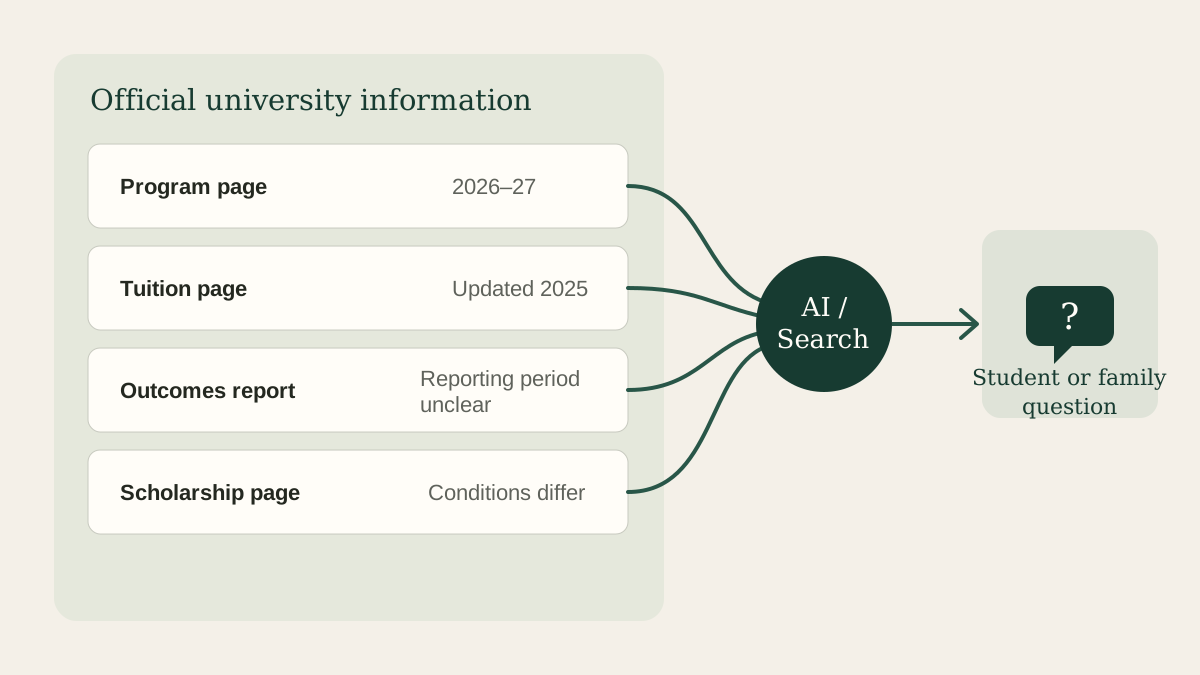
That is why the first AI-search project for many institutions may be an information audit rather than a content-production exercise.
AMB already uses information-gap analysis and decision architecture in international enrollment work: identify the questions that affect a decision, examine what a student or family can actually find, and determine whether the available information is sufficient to act. AI adds another place where those answers may be encountered; it does not change the underlying requirement that the answers be accurate.
A useful standard does not depend on an algorithm
For each consequential question, an institution can identify the page or source that owns the answer. Claims about outcomes can point to dated evidence. Tuition, deadlines and policies can state the period in which they apply. Internal links can connect related questions without requiring a reader to understand the university’s organizational chart.
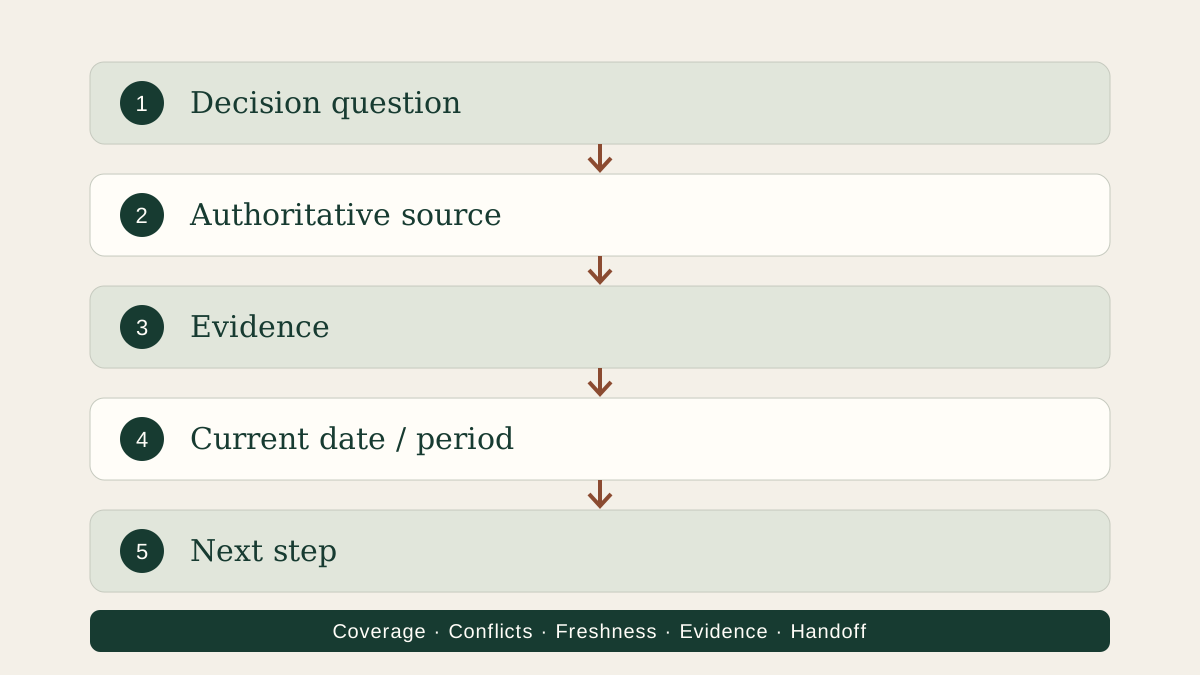
The same review can expose contradictions between pages, outdated PDFs, unsupported claims and important questions that have no clear answer at all.
Those are measurable problems. An institution can track how many high-priority questions have an authoritative source, how often conflicting information appears, how quickly time-sensitive pages are updated, and whether an answer provides a sensible route to the next step.
None of those measures requires a prediction about how ChatGPT, Google, Bing or another system will rank or cite a page next year.
There is room to experiment with GEO and AEO as the technology develops. Institutions should test carefully, document what changes, and be skeptical of guaranteed visibility or citation claims.
Much of the work is familiar: publish information the institution actually knows, keep it accurate, show where the evidence comes from, update it when circumstances change, and make it understandable to the people making the decision.
If AI becomes a larger part of college search, those qualities become more valuable, not less.
Decision Experience
See where your institution's answers become hard to find or verify.
If you want an outside view of how prospective students and families encounter your institution across search, AI-assisted research, localized channels, and owned pages, AMB can prepare a tailored research + strategy overview proposal of up to 20 pages at no cost. We can also spend up to one hour discussing the findings with your team. There is no commitment required, and we will give you candid, practical recommendations even if you decide not to proceed with AMB.
AMB Insights
Stay ahead of international enrollment shifts.
Get AMB Insights on international enrollment strategy, China-market intelligence, and market-specific enrollment infrastructure.