China Market
What Does It Really Cost to Enroll Chinese-Speaking Students at Independent Schools?
One enrollment-cost figure can conceal two recruitment markets, several budgets, and a long path to the admissions office.
What does enrollment cost when spending is scattered across teams and families encounter a school long before their first inquiry? A practical look at Chinese-speaking recruitment.
A school’s admissions budget may show precisely what it spent on advertising. The business office may hold agency invoices, while Marketing pays for translated materials and staff devote hours to community events. When leadership asks what it cost to enroll a student, those pieces do not always meet in the same report.
The National Association of Independent Schools’ 2025 Cost Per Enrollment Study, published in April 2026, identifies this problem directly: the necessary data may sit in different offices, be combined inconsistently, or never be collected. For schools recruiting Chinese-speaking families, there is another complication. The first encounter with the school may happen long before Admissions receives an inquiry.

The journey begins in different places
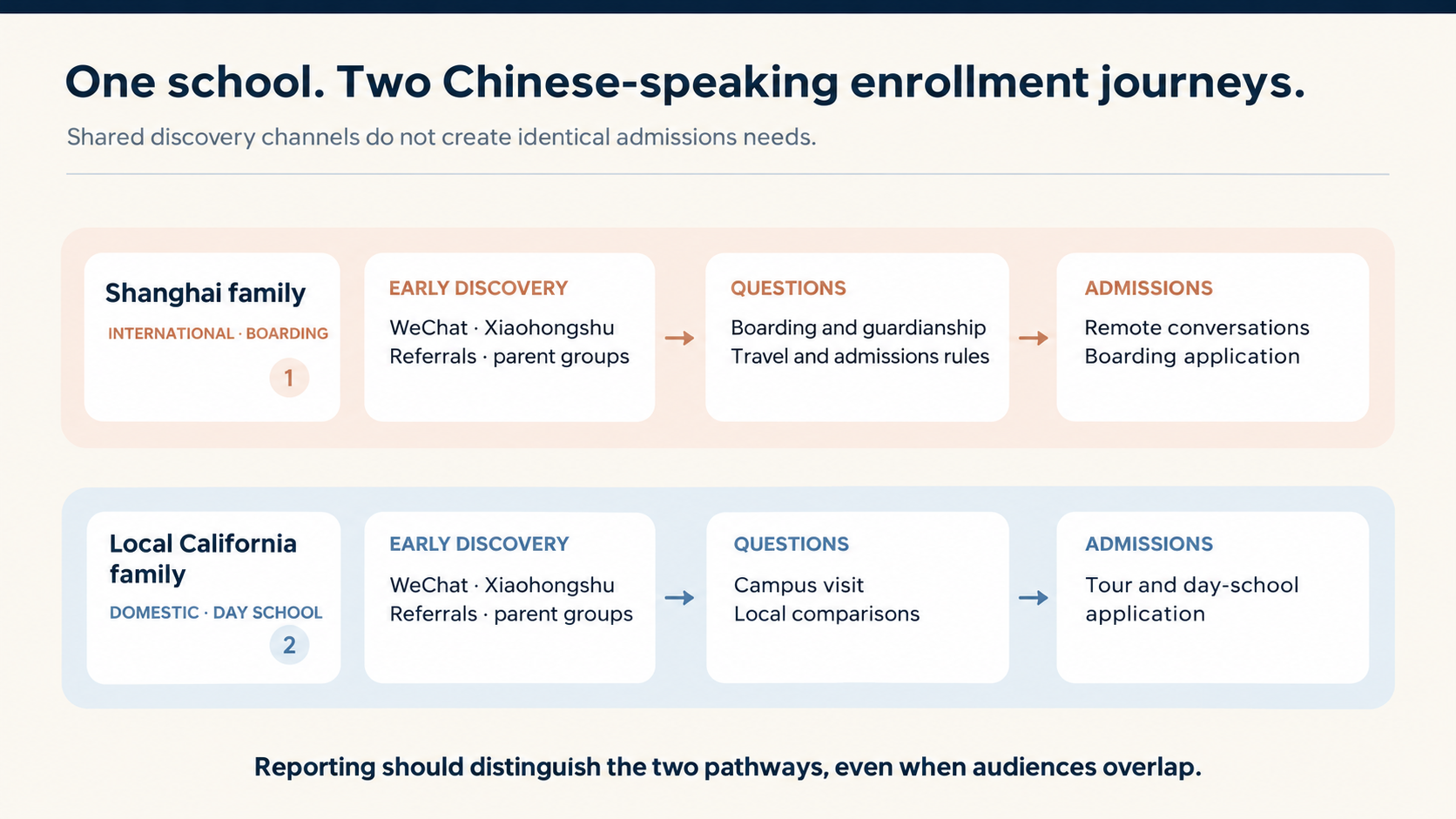
Consider two prospective families exploring the same independent school, which offers both boarding and day programs. One lives in Shanghai and is considering boarding. The other lives twenty minutes away in Southern California and is interested in the day program. Both prefer to research in Chinese and may encounter school content on WeChat or Xiaohongshu, alongside referrals and conversations with other parents.
Their decisions diverge quickly. The overseas family may need information about boarding, guardianship, travel, and international admissions requirements. The local family can visit campus, compare nearby schools, and ask neighbors about day-to-day experience. The same Chinese-language post could reach either family, yet a single “China campaign” label would obscure the distinction.
Research on Mandarin-speaking parents offers insight into how these information networks operate. A 2025 qualitative study published in Race Ethnicity and Education interviewed 24 mothers navigating public-school choice in a U.S. urban district, including 13 Mandarin-speaking and 11 Spanish-speaking participants. Most (83%) were from low-income households. Mandarin-speaking parents described using WeChat groups to exchange application guidance and practical information. Although conducted in a public-school setting, the study highlights a community-based information pathway that independent schools may also need to examine when evaluating how families discover and research their options.
What a $5,000 enrollment cost leaves out
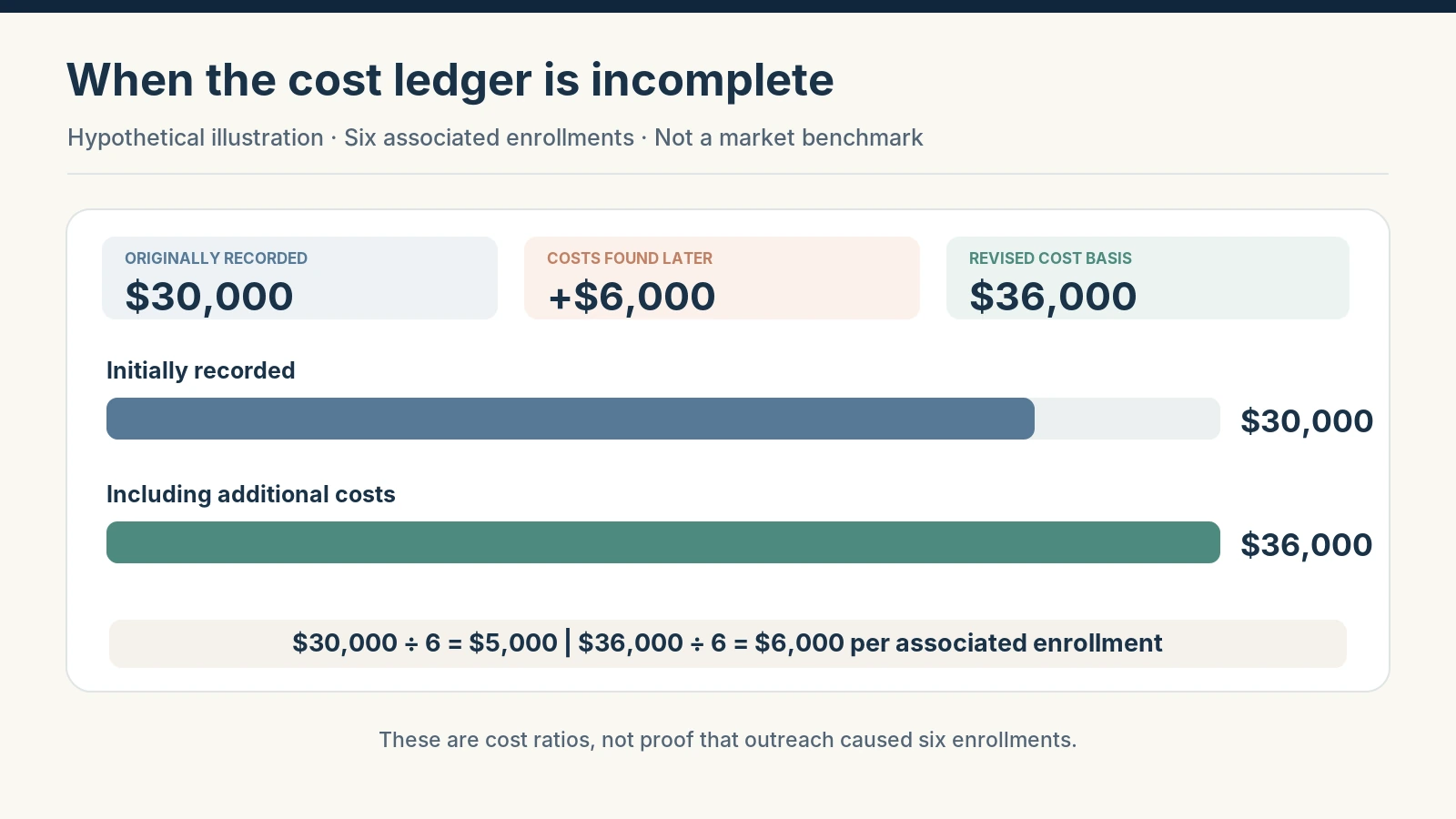
Consider a hypothetical independent school. It spends $30,000 annually on Chinese-speaking outreach and enrolls six students who had contact with those activities. The initial calculation is $5,000 per associated enrollment, without establishing how much the outreach contributed to each family’s decision.
Finance then identifies another $6,000 in translation, staff time, and community-event expenses recorded elsewhere. Including those costs raises the figure to $6,000 per associated enrollment. The revised calculation captures previously overlooked spending, but the school must still determine how those costs should be allocated.
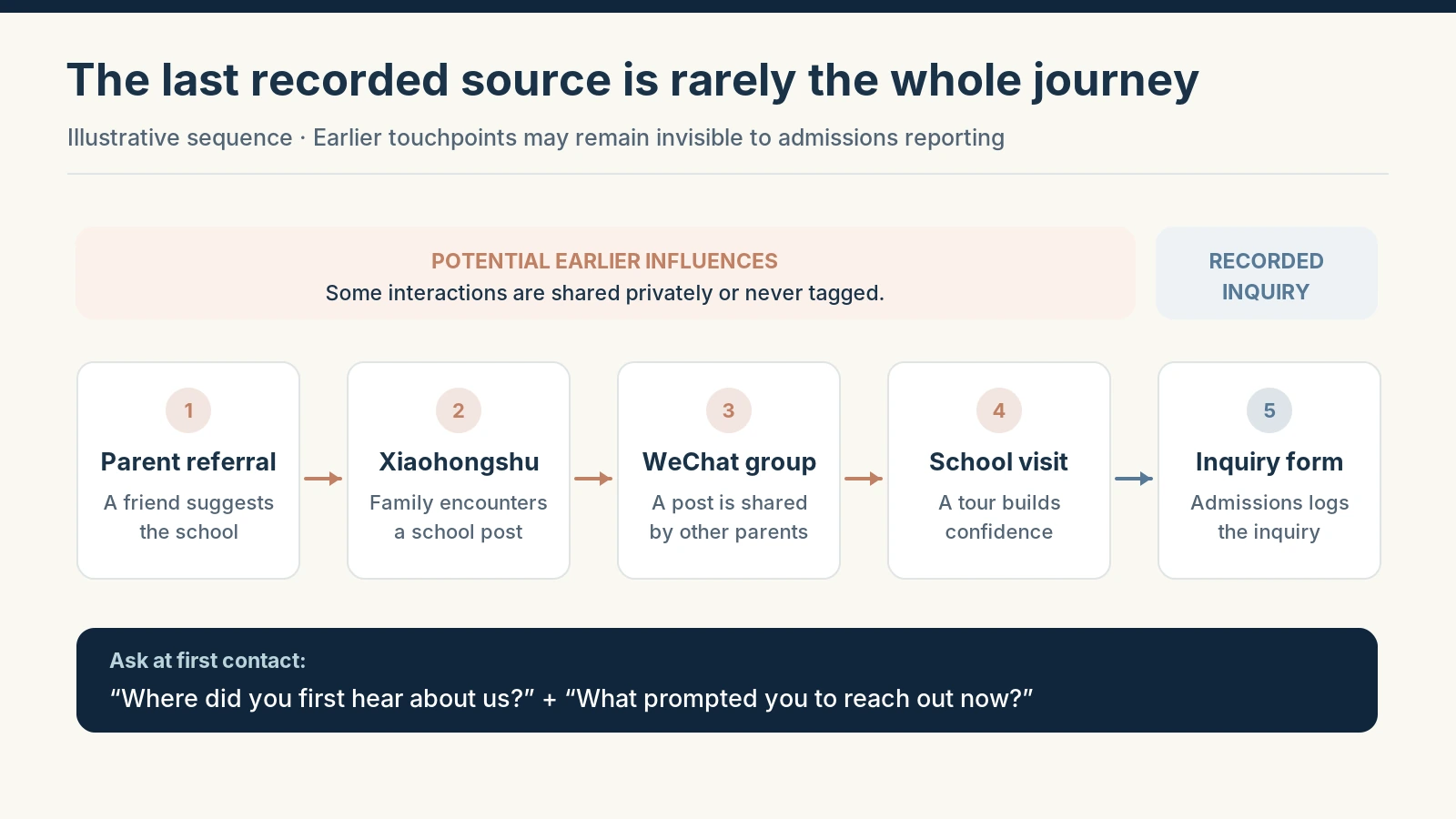
Some activities serve local families, while others support international recruitment. Chinese-language content may remain useful across multiple enrollment cycles. A family might first discover the school through a friend’s recommendation, encounter its Xiaohongshu content, and later arrange a campus tour through Admissions.
Consider what happens when leadership reviews Xiaohongshu spending. Few enrolled families may have selected the platform as their inquiry source, making its recorded contribution appear limited. Yet some could have encountered its content earlier through posts shared in WeChat parent groups.
If reporting captures only the final inquiry source, channels that generate easily tracked inquiries may appear more valuable than earlier influences that remain undocumented. A school could consequently reduce spending on a useful discovery channel while retaining investment in channels that receive disproportionate credit.
Whether this bias exists at a particular school requires investigation. Asking families where they first encountered the institution and which subsequent interactions influenced their decision provides a stronger basis for comparing recruitment investments.
Build a record that follows the decision
A useful starting point is a joint review by Business, Marketing, and Admissions. Recruitment expenses should include external fees, internal labor, content production, platform operations, and events, with shared costs identified rather than arbitrarily assigned.
At the first meaningful contact, Admissions can ask how families originally heard about the school and what prompted them to inquire. With appropriate consent, these responses can accompany residency, program interest, tour activity, applications, and confirmed enrollment.
Local and international pathways should be examined separately, even when families encounter the same Chinese-language content.
The resulting picture may change budget priorities. If overseas prospects regularly inquire but struggle to arrange timely conversations, additional advertising may be less useful than improving admissions follow-up. If local families discover the school through community referrals and subsequently attend campus tours, those relationships deserve consideration alongside paid-media reports.
In our work for SCAD, we built a China-hosted website, established an official WeChat presence, and connected Chinese-language inquiries to the university’s U.S. admissions CRM through an SCRM workflow. SCAD is a higher-education institution, so the project illustrates an approach to connecting market engagement with admissions records rather than a demonstrated K–12 enrollment result.
Before increasing or cutting spending in Chinese-speaking markets, school leaders need to understand where families first encountered the institution and how those interactions eventually reached Admissions. A budget that measures only the final inquiry may appear precise while overlooking earlier investments that helped bring families into the admissions process.
Enrollment Cost Review
See which recruitment costs and early touchpoints your records miss.
Review how your school records outreach spending and how Chinese-speaking families first find you. Comparing local day and international boarding pathways can help your team decide where better evidence would inform the next budget.
AMB Insights
Stay ahead of Chinese-speaking market shifts.
Get AMB Insights on Chinese-speaking market intelligence, enrollment strategy, and market-specific enrollment infrastructure.