China Market
Why Universities and Schools Must Treat Social Media as Reputation Infrastructure
Publishing builds visibility. Listening to students, alumni and families helps institutions earn trust—and learn what needs to change.
Social media now lets students and families test school claims against current students, alumni and institutional responses. A practical Chinese-platform listening model helps schools build and protect trust.
University websites, rankings, graduate outcomes and institutional news still help families judge a school. But a polished official story is no longer the only story available. Prospective students can ask current students about daily life, hear alumni describe what happened after graduation, and watch how a school responds when criticism surfaces.
Social media has become a place where institutional claims are tested against lived experience. For enrollment and marketing leaders, that makes it more than a publishing channel.

The research journey now includes other people’s voices
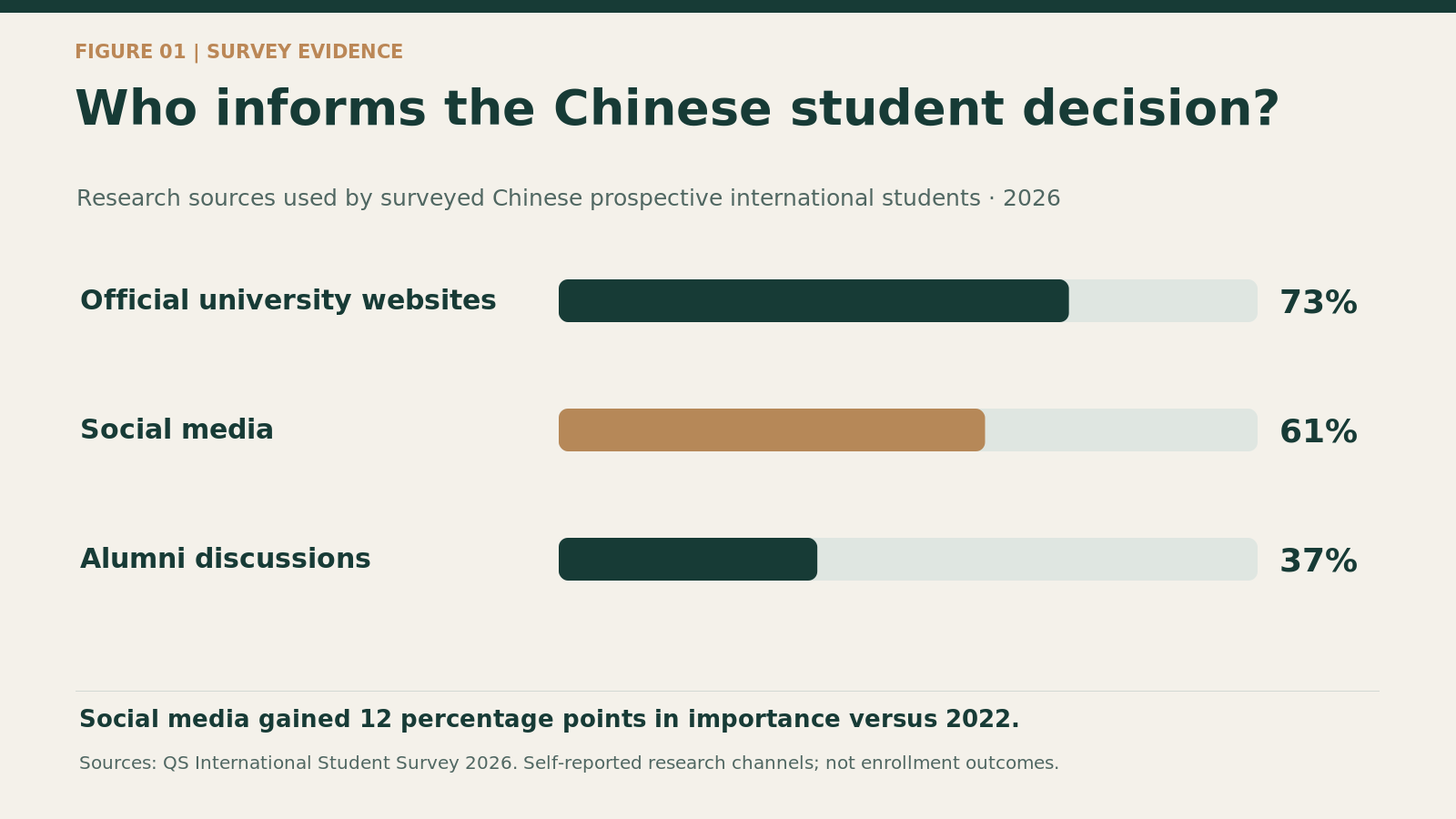
The QS International Student Survey 2026 reports that 61% of surveyed Chinese prospective international students used social media to research study options; 37% drew on alumni discussions. Another QS analysis reports 73% used university websites, while social media’s importance rose 12 percentage points since 2022. These are reported information-source preferences—not evidence that social posts caused applications or enrollments.
Our earlier family-decision analysis explains why the applicant is not always the only voice in a school selection.
The important distinction is not official versus unofficial. A prospect may use both. A university can explain its curriculum; a student can describe the classroom experience. An independent school can publish pastoral-care policies; a parent can ask another family how communication actually works. Neither personal testimony nor a viral complaint is automatically representative. Yet both may expose a question that official content has failed to answer.
Reputation cannot be managed by posting more often
Traditional school marketing broadcasts a message. Social platforms also let people question, compare, challenge and respond. If an institution treats WeChat or Xiaohongshu as a one-way noticeboard, it has created another television channel—not a relationship.
A 2025 peer-reviewed study in Higher Education Quarterly examines how student satisfaction and positive or negative electronic word-of-mouth relate to university image. Its findings are context-specific; they do not establish a universal enrollment effect. They do, however, support taking student-generated discussion seriously.
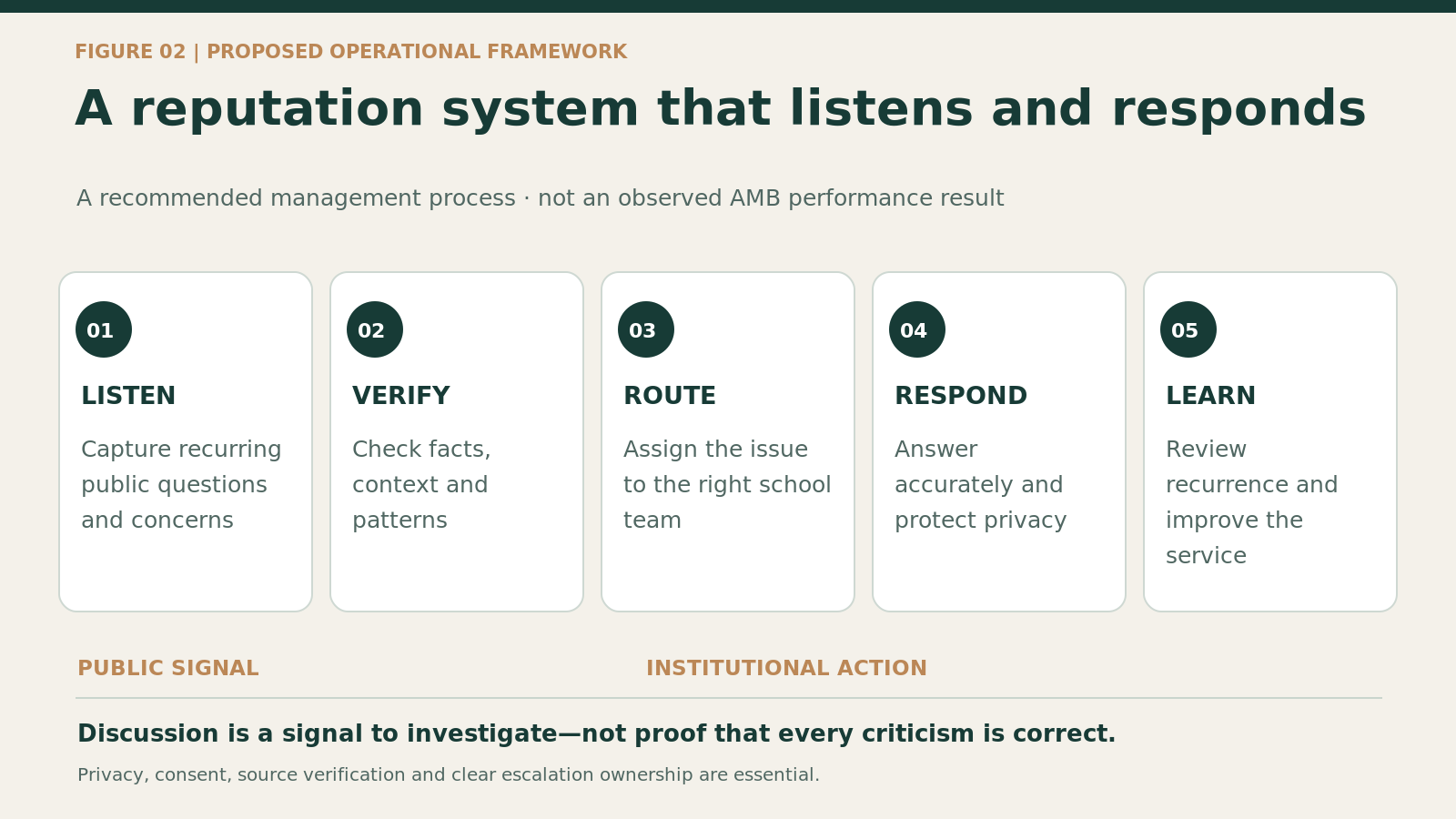
The answer is not to control what students say. It is to establish a listening discipline: identify recurring public questions; distinguish opinion from a verifiable factual error; assign concerns to the right institutional owner; correct inaccuracies transparently; and check whether the underlying issue was addressed. Protect privacy and keep confidential grievances outside public comment threads.
Alumni bring the longer view
A current student can speak to today’s teaching, housing or support. Alumni can test the institution’s promises over time. They can explain which courses and relationships proved useful, what obstacles they encountered, and how their careers or further study unfolded.
That is stronger than collecting flattering quotes. Invite graduates from different programs and pathways into honest, permission-based conversations. Disclose sponsored relationships. Do not present one exceptional graduate as proof of a program-wide placement rate, income level or outcome.
For prospective families, a credible alumni account may not provide certainty—but it can make their next question more informed.
Chinese-speaking reputation crosses borders
This work matters on WeChat and Xiaohongshu (RED) and other Chinese-language platforms used by relevant communities. It is not limited to mainland-China recruitment. Institutions may also serve Chinese-speaking students and families already living in the United States, while recognizing that domestic and international applicants have different eligibility rules and decision journeys.
Our SCAD work connected a China-hosted site, official WeChat presence and inquiry workflow to U.S. admissions systems. Our Wycombe Abbey engagement documents Chinese-platform monitoring, factual corrections and risk escalation. IMG Academy is also listed among our education partners, without a published project-level outcome we can responsibly attribute here. These examples demonstrate relevant capabilities—not a claim that social listening itself increased enrollment.
Make listening part of enrollment management
Start with a small, accountable operating loop. Track recurring themes, unanswered questions, response timeliness and whether issues reach the right team. Bring patterns to admissions, student services, communications and alumni relations. Then check what changed.
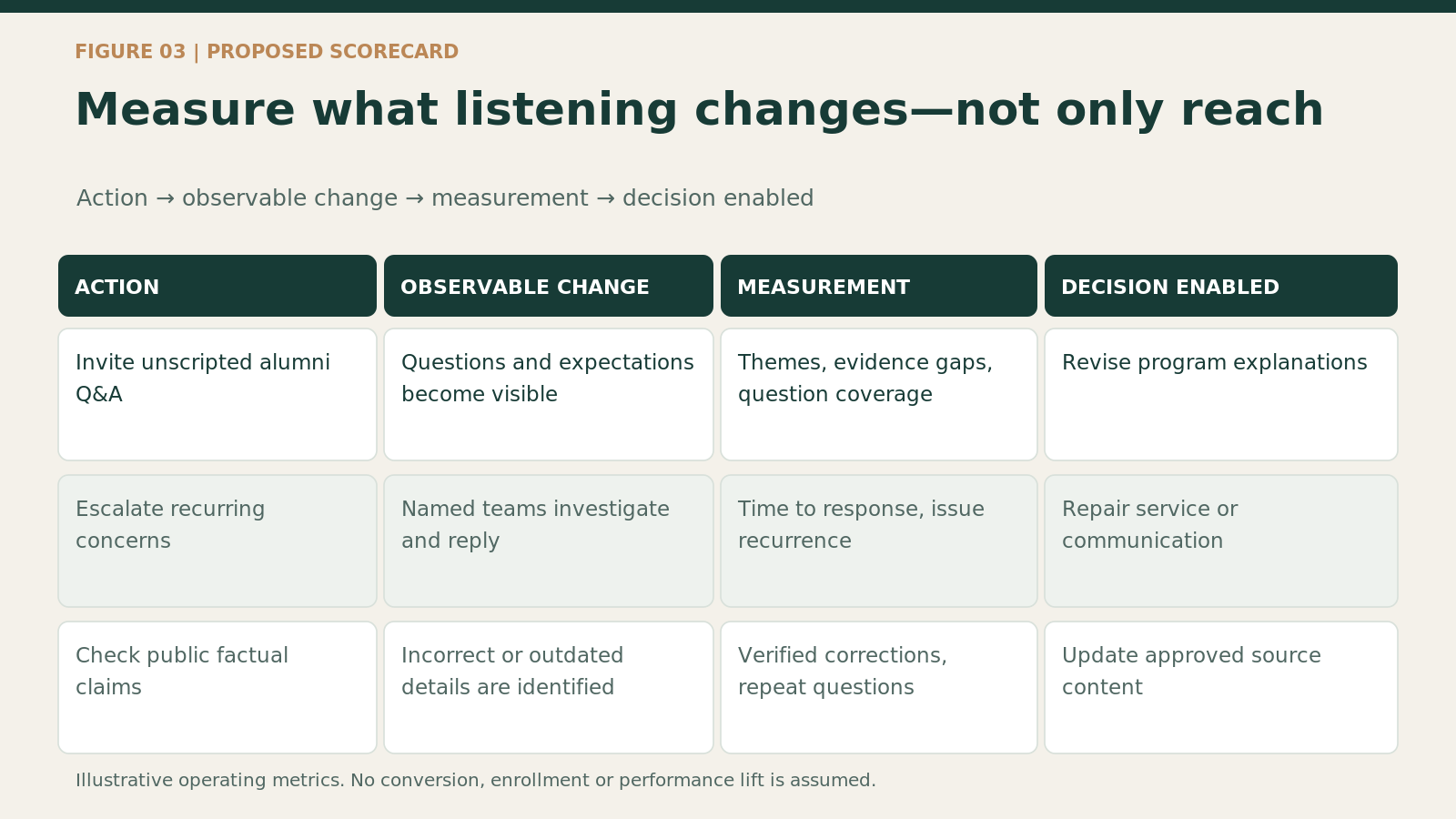
Where privacy rules permit, compare recurring questions before and after a clarification, and whether platform inquiries reach an authorized school contact. These measures do not prove a recruitment effect; they show where information, staffing or service needs attention.
For example: invite unscripted alumni Q&A → uncover recurring expectations → classify and review the questions → decide which program explanations need revision. Or: route a repeated service complaint → document a response and service change → monitor recurrence → decide whether further intervention is needed. These are measurable learning outcomes, not promises of higher conversion.
Reach can tell leaders how widely a message traveled. Replies and independent experiences can tell them where trust is strengthened—or tested. The institution that only broadcasts may be heard. The institution that listens has a better chance to understand what deserves to be believed.
Note: The 2025 peer-reviewed paper is historical research context, not a causal enrollment study.
China-Market Reputation & Trust
What are students and alumni saying where your admissions team cannot see?
We can review the public Chinese-language conversations, official information and response paths shaping how your institution is understood. Anyone who contacts AMB may receive, at no cost, a tailored research + strategy overview proposal of up to 20 pages, plus up to one hour of discussion with our team. No commitment is required. We provide candid, practical recommendations even if your institution decides not to proceed with us. We do not promise reputation, inquiry, conversion or enrollment results.
AMB Insights
Stay ahead of Chinese-speaking market shifts.
Get AMB Insights on Chinese-speaking market intelligence, enrollment strategy, and market-specific enrollment infrastructure.