China Market
What We Found When We Looked for U.S. Schools on Chinese Platforms
Findings from AMB's working registry of 261 institutions, with platform checks conducted in October–November 2026.
In AMB's expanded 261-school registry, verified institutional accounts on WeChat and Xiaohongshu were uncommon. The findings point to a broader problem of authority, maintenance and reliable admissions information.
An account using a university’s name and seal appeared during our search of WeChat. It had no platform certification and no biography. In another search, a page presenting itself as a university’s official presence was advertising discounted application consulting. Neither qualified as an institutional account under our verification rules.
There is a difference between finding a school’s name and finding a source that the school actually controls. For parents trying to check an application requirement or identify the right admissions contact, that difference can be hard to spot.
We encountered these examples while expanding AMB’s research on how U.S. universities and independent schools appear on WeChat and Xiaohongshu (also known as RED). Our original 2026 China Visibility Census examined a structured group of 100 institutions. Our wider working registry now contains 261 schools, collected through research, screening and outreach. For 201 of them, we have recorded a status for both platforms.
The expanded registry is not a national survey. Schools entered it for different reasons, and some were selected for outreach precisely because their Chinese-platform presence looked limited. Its results cannot tell us what proportion of all U.S. schools have official accounts. They do, however, give us a closer view of a problem that can be easy to miss from inside an admissions office.
Verified accounts were uncommon in the schools we checked
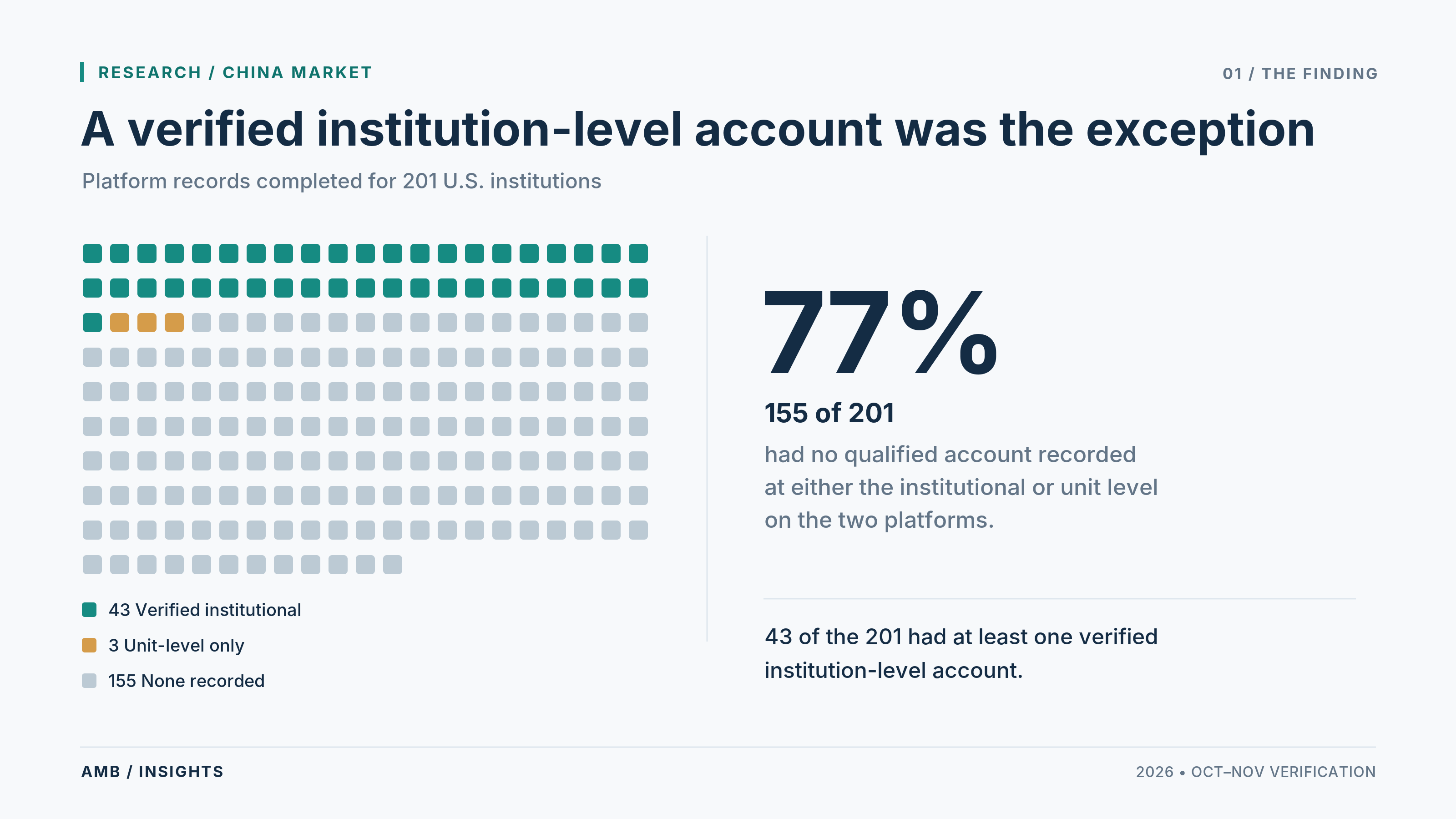
Among the 201 institutions with both platforms checked, 43 (21%) had a verified institution-level account on at least one platform. The breakdown was straightforward: 9 had verified accounts on both, 31 had WeChat alone, and 3 had Xiaohongshu alone. The other 158 had no verified institution-level account on either platform.
That final group needs a distinction. Three of the 158 had an account identified at the unit level but not at the institution level. In 155 cases (77% of the 201), our checks found no account at any level on either platform. An absence in this record means not found through our recorded platform checks; it does not mean that no Chinese-language information about the school exists elsewhere online.
Looking at each platform separately, 46 of 211 institutions with a completed WeChat status had a verified institution-level account (22%). For Xiaohongshu, the figure was 12 of 201 (6%). The denominators differ because not every school in the registry has a completed check for both platforms.
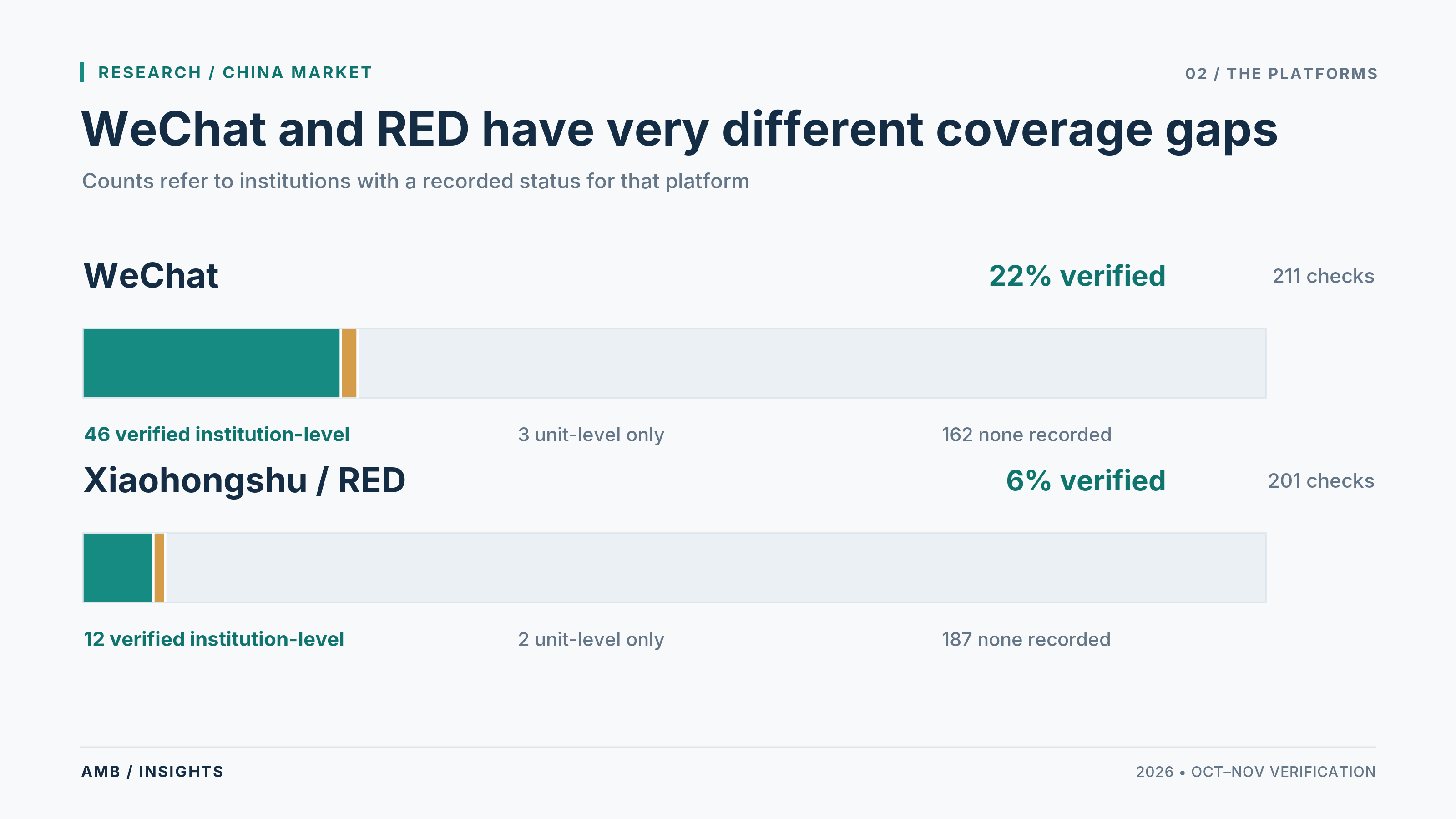
WeChat’s larger showing is consistent with its use as an official publishing and contact channel. Xiaohongshu is different: prospective students and families can encounter personal accounts, informal advice and recommendations alongside institutional posts. Both environments can shape what someone learns about a school, but an institutional account serves a different purpose from a third-party discussion.
An account with the right name may still be the wrong source
Certification mattered in this review. We counted an institutional account only when the platform’s verification information identified the school or an authorized operating agency. An account that looked school-related but could not be verified did not qualify.
That rule excluded more than obvious impersonation. We also found an independent school’s account posting open-house information under the school’s genuine admissions email address, but without platform certification. The content may have been school-run; the account could not be counted as verified under the same standard applied to everyone else. Other searches surfaced empty accounts holding a school’s name, or accounts associated with academic units rather than the institution as a whole.
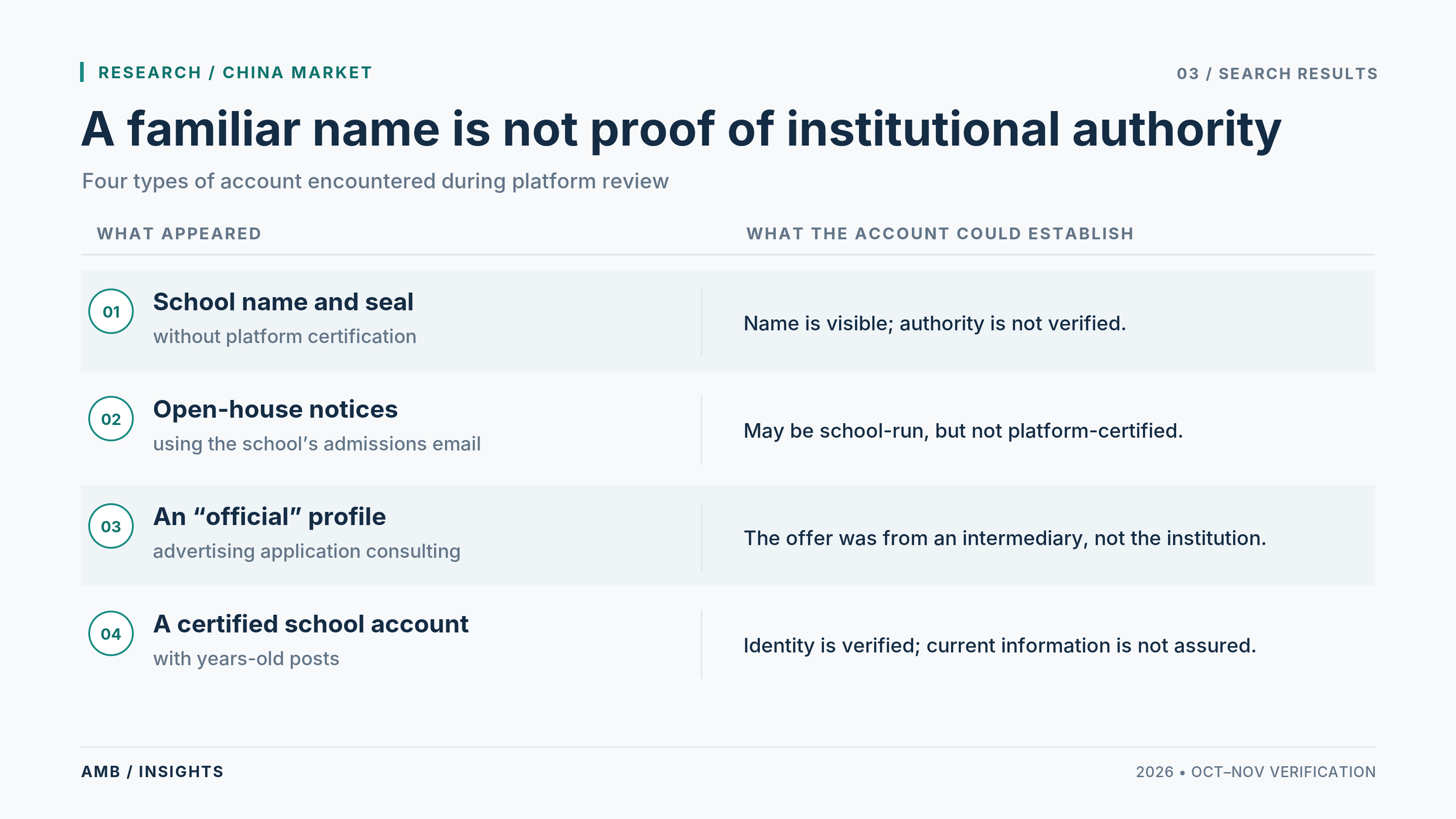
This is why a school’s internal view of its China communications may differ from a family’s search results. A marketing team may know which agency manages its content. A parent arriving through search may see several similarly named accounts and no easy way to tell which one has authority to speak for admissions.
A useful first check is therefore not simply, “Do we have a WeChat account?” It is whether someone unfamiliar with the school can identify the right account and reach current, institution-approved information from it.
Some official accounts had stopped talking
Verification is only the first test. We also recorded whether an official account had published within the preceding 90 days.
Of the 46 verified institution-level WeChat accounts, 24 showed activity within that window and 14 did not. The activity field was unavailable for 8 others, so those eight should not be classified as either active or inactive. Some of the dormant accounts in our research had last published years earlier, including accounts operated by or for recognizable institutions.
Xiaohongshu showed 8 active accounts out of 12 verified, with 2 inactive and 2 without a clear activity reading. Those are small numbers, and they do not establish that institutions manage Xiaohongshu better. They show why account counts alone tell an incomplete story.
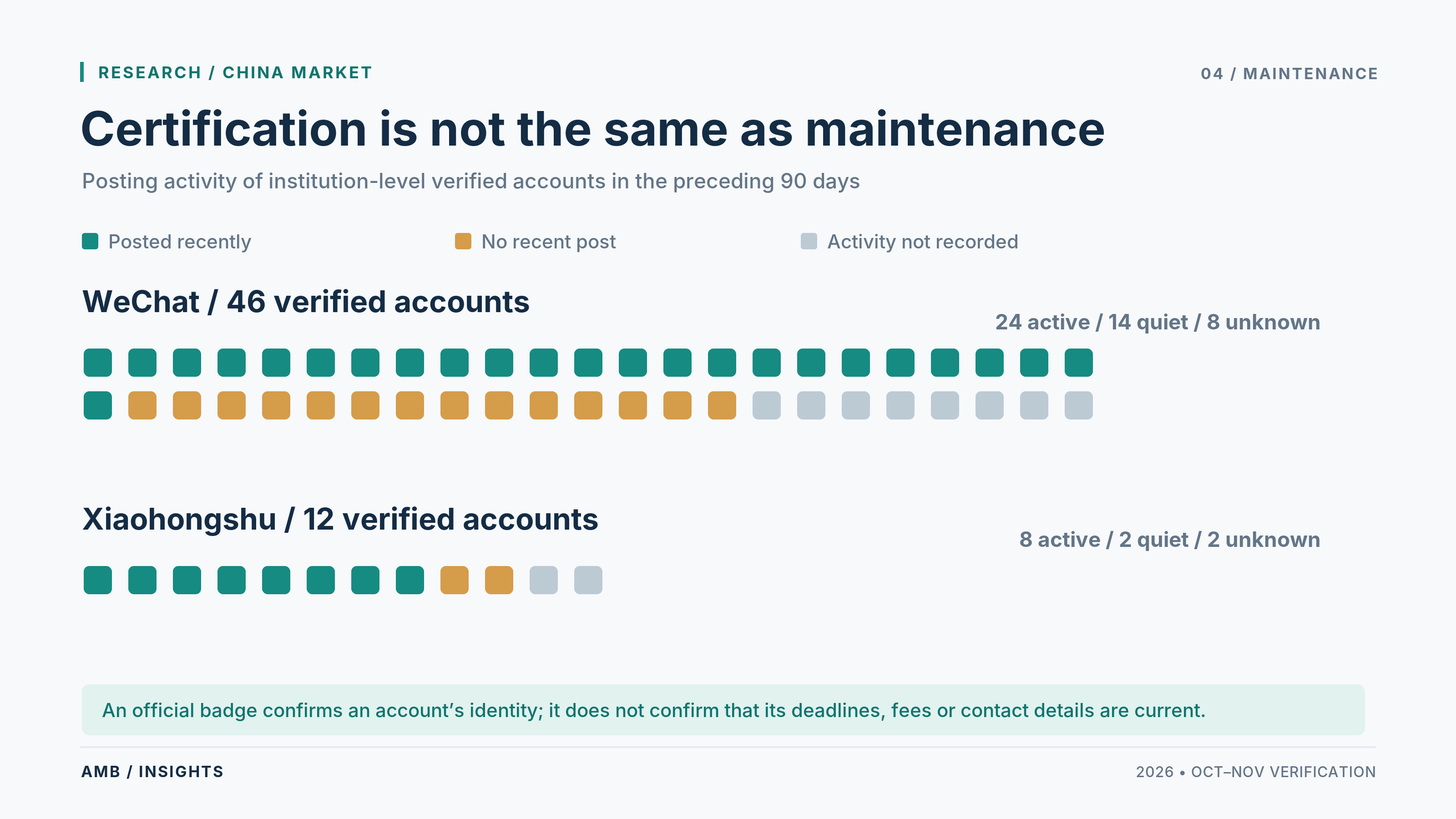
An official account that last posted about a past application cycle may still appear credible because it is certified. A family can save or forward that page without knowing whether the information is current. The operational question is less about posting frequency than about whether deadlines, costs, entry requirements and contact details are being maintained as those facts change.
The problem reaches beyond social media
For a school, maintaining Chinese-language admissions information crosses several departments. Admissions knows when requirements and deadlines change. Finance or the business office approves tuition and fee figures. Marketing manages how the information is presented. If an external agency publishes on the school’s behalf, someone still needs to approve updates and retire outdated material.
Those responsibilities are especially important when students and families compare a school through screenshots or forwarded posts rather than a live admissions page. A fee figure copied from an old post can circulate long after the school changes its published charges. An application deadline can remain visible even when a new cycle has begun. Our platform registry does not measure how often families encounter these errors or whether they affect enrollment decisions. It does show how rarely many of the institutions we checked had a verified channel through which to correct or clarify them.
The broader recruitment environment adds urgency, although it should not be confused with evidence from our platform review. IIE’s Open Doors 2026 reports 254,458 students from China enrolled at U.S. colleges and universities in the 2025/26 academic year, a 4.3% decline from the prior year. That figure covers higher education, not the independent schools also represented in our registry. It provides context for enrollment planning; it does not by itself explain how Chinese families use either social platform.
Schools do not need to translate their entire websites or start publishing daily to address the basics. The more immediate task is to make five pieces of information easy to find and keep current in Chinese: total cost, application deadlines, admission requirements, the application process and a trustworthy contact point. Depending on the institution, those answers might live on a Chinese-language page on its own website, a verified social account, or both. What matters is that the sources agree and have an owner.
Start by checking the search journey
We would begin with a small exercise involving admissions and communications staff. Search for the school in Chinese and English on both platforms. Record which accounts appear, what they claim to be, whether their verification can be confirmed, and whether the information they publish still applies to the current admissions cycle. Include unofficial results; they are part of what a family may see.
Then choose one authoritative source for the essential admissions facts, assign responsibility for updates, and make sure any social accounts point back to it. If a verified account has been inactive for some time, decide whether it can be maintained or whether its profile should direct families to a current institutional resource. It is better to make that choice deliberately than to leave an apparently official page unattended.
The findings here are limited to the institutions and channels in our working registry. Still, they raise a practical issue for schools of very different sizes: when someone searches for your institution in Chinese, is there a reliable way to tell which information comes from you? That question can be tested without launching a campaign or committing to a new content calendar.
About the research
AMB’s 261-institution working registry was assembled during 2026 from a structured 100-school census group and additional schools considered through research, screening, proposal preparation and outreach. This produces selection bias: for example, some outreach screens favored schools with limited established Chinese-platform activity. The registry is not a random or representative sample, and the percentages above describe only the checked records.
Platform status was reviewed in October–November 2026 through a combination of in-app checks and documented screening. WeChat status is recorded for 211 institutions and Xiaohongshu status for 201; both are recorded for the same 201 institutions. The remaining 50 WeChat and 60 Xiaohongshu entries have no completed status and were excluded from the relevant calculations. An unchecked institution was not treated as absent. Because accounts can change, the results are a record of the review period rather than a permanent directory.
Our verification standard required platform certification identifying the institution or its authorized operating agency. Uncertified accounts, alumni accounts, unit-level accounts and third-party accounts were tracked separately where identifiable. The registry’s platform findings should not be read as a test of the completeness or accuracy of all schools’ Chinese-language websites or admissions materials; that separate content review was performed only for the original 100-school census group.
Sources
- Institute of International Education (IIE), Open Doors 2026, U.S. enrollment figures for students from China.
- AMB Digital Agency, 2026 China Visibility Census, structured 100-institution research sample.
- AMB Digital Agency, Schools Master Record, 261-institution working registry, platform checks conducted in October–November 2026.
Chinese-Platform Visibility
Check what families find when they search for your school.
Start a conversation about how families can identify your official accounts and reach current admissions information on Chinese platforms.
AMB Insights
Stay ahead of Chinese-speaking market shifts.
Get AMB Insights on Chinese-speaking market intelligence, enrollment strategy, and market-specific enrollment infrastructure.